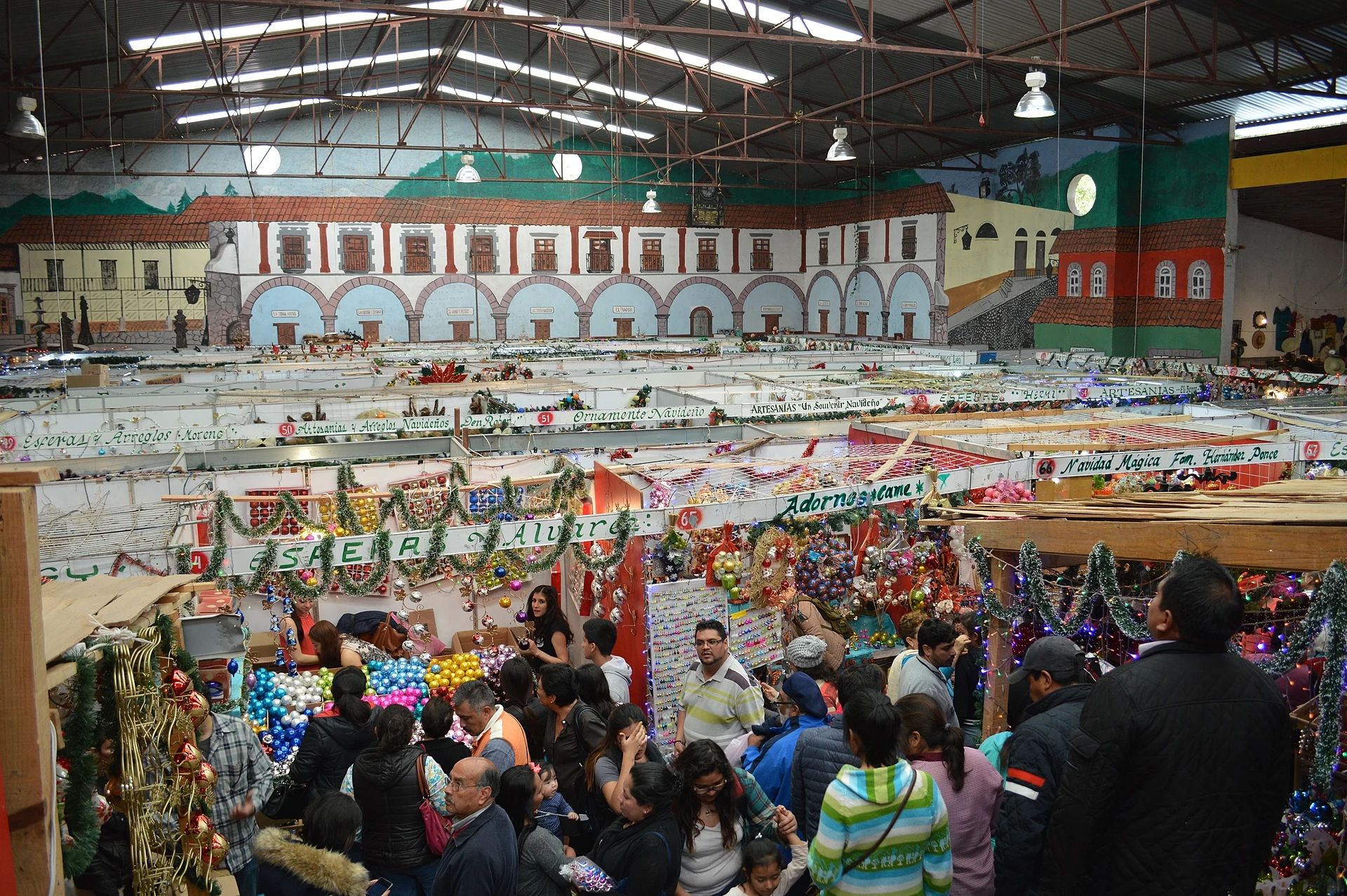
For about ten weeks before Christmas, a cold mining town in the mountains of eastern Michoacán turns into one big ornament market, with hundreds of family workshops selling glass esferas straight from the kiln.
Tlalpujahua sits at about 2,600 meters on the border with the State of Mexico, a steep town of cobbled streets and red-tiled roofs that grew rich on gold and silver. When the last big mine closed in 1959, the town found a second trade in blown-glass Christmas ornaments, and it now makes tens of millions of them a year. Every autumn the Feria de la Esfera gathers the makers in the municipal auditorium and along the main streets, and the town decorates itself to match.
The 2026 fair, the 27th, opened on October 7 and runs until December 18, and entry is free; organizers expect more than 650,000 visitors. Weekdays are quieter and good for watching the workshops; the monumental tree is lit on November 13, parades follow on Saturdays, and weekends get very busy. It is cold, especially after dark, so bring a warm jacket. Combine it with El Oro, the mining Pueblo Mágico a few kilometers away across the state line.
The trade came home with Joaquín Muñoz Orta, a Tlalpujahua man who worked in a Chicago factory making artificial Christmas trees in the 1950s. Back in Mexico in the early 1960s he opened a small tree workshop in Mexico City, added glass ornaments when they outsold the trees, and by the end of the decade had moved the business to his hometown. That company still runs several plants, and around it hundreds of smaller family workshops grew up.
Each esfera starts as a glass tube heated over a flame and blown by mouth into a bubble, without a mold, so no two are exactly alike. The bubble is then silvered on the inside to make it shine, dipped or painted in color, and finished by hand with glitter, painted scenes, names or figures. Blowing is mostly men's work and painting mostly women's, and in many houses the whole family takes part. Many workshops let visitors watch, and some let you try decorating or even blowing a piece.
Most of the fair happens in the municipal auditorium, packed with stalls, and along the streets around the center, where workshops open their front rooms as shops. Prices start at a few pesos for a plain sphere and go up to more than a thousand for large hand-painted pieces; at the 2025 fair they ran from about 3 to 1,500 pesos. Beyond classic spheres you will find glass fruit, bells, snow globes, skulls, nativity figures and sports-team or cartoon designs, and many makers will paint a name or a photo on a sphere while you wait or by the next day.
Buying from the person who made it gets you the best price and a better story; it is normal to ask for a discount when you buy by the dozen or the box. Ask for your pieces to be wrapped in newspaper and boxed, and carry them by hand rather than in the trunk. Pine-cone wreaths, pine-needle baskets, local pottery, honey and bread are sold alongside the glass.
Stalls are open from the first day, but the fair builds up through the season. In 2026 the monumental Christmas tree is lit on Friday November 13 at 7 pm on the esplanade of the Museo Hermanos López Rayón, and the town's tourism office announced six Christmas parades for November 14, 21 and 28 and December 5, 12 and 16. In recent years the main square has had nightly light shows, video mapping and carols, and in 2025 a Christmas village of Tudor-style houses, Villa Claus, was set up as a corridor of workshops and shows. The tourist police and the state Guardia Civil patrol the fair.
November 13 is also Tlalpujahua's own day: the López Rayón brothers, heroes of the War of Independence, were born here, and schools parade and stage plays about them, so the tree lighting falls on a festive day. Check the town hall's social media for times and changes.
The town in December: the Carmen, the mines and the butterflies
Leave time for the town itself. The Santuario de Nuestra Señora del Carmen, the parish church of San Pedro y San Pablo, holds the image of the Virgen del Carmen painted on an adobe wall: on May 27, 1937 a mudslide buried a third of the town and killed more than 400 people, and the wall that survived was carried more than a kilometer and a half to the church by thousands of residents. Only the bell tower of the old chapel still sticks out of the ground where it stood. The house where the López Rayón brothers were born is a museum of the town's mining past and the War of Independence.
Just outside town, on the road to El Oro, the Las Dos Estrellas mine, one of the richest gold mines in the world in the early twentieth century, is now a museum with original buildings and tunnels. The Brockman dam, a few kilometers away, is good for a walk among pines. In winter the monarch butterflies settle in the forests to the south; the Sierra Chincua sanctuary is about 20 to 30 km away, so a December visit can include both once the sanctuaries open for the season.
Day by day, 2026
The fair opens
The 27th Feria de la Esfera opened, with stalls in the municipal auditorium and workshops open around town.
López Rayón day and tree lighting
At 7 pm the monumental Christmas tree is lit on the esplanade of the Museo Hermanos López Rayón. Christmas parades start the next day.
Posadas begin
The nine nights of posadas start across Mexico, and the town announced its last Christmas parade for today. Two days left of the fair.
Last days of the fair
Last day of the 2026 fair as announced by the state crafts office and the town. Workshops and shops keep selling all year.
Getting there
From Mexico City
About 170 km, two and a half to three hours by car: take the Circuito Exterior Mexiquense and the Arco Norte toward Atlacomulco, then the turnoff toward Temascalcingo and on to Tlalpujahua. In 2024 the tolls one way came to about 330 pesos. Without a car, a day tour from Mexico City to Tlalpujahua and El Oro is simpler than piecing together buses.
From Morelia
About 135 km by the Morelia–Maravatío toll road (15D); leave it at Maravatío and follow the signs north to Tlalpujahua. Allow an hour and a half to two hours.
From Querétaro
About 120 km, roughly two hours: head south toward San Juan del Río and Atlacomulco, then follow the signs to Tlalpujahua.
From Toluca or Guadalajara
From Toluca, drive north to Atlacomulco and on to El Oro, about 96 km, then cross into Michoacán to Tlalpujahua. From Guadalajara, take the 15D toll road east past Morelia to Maravatío and turn north there.
Where to stay
Tlalpujahua has small hotels and guesthouses in old houses around the center and cabins in the pine woods outside town; for a November or December weekend, book ahead, and ask whether the room has heating or a fireplace, because nights are cold. Staying over lets you see the lights and the square at night and reach the workshops early, before the day-trip crowds arrive.
El Oro, a few kilometers away in the State of Mexico, has its own hotels and is a good second base, especially if you also want to see the monarch sanctuaries. Many visitors simply come for the day from Mexico City, Morelia or Querétaro.
The ornament capital itself. Spend a morning in the workshops watching the blowing and painting, an afternoon in the auditorium and the stalls around the center, and stay for the lights in the square. Add the Santuario del Carmen, the Las Dos Estrellas mine museum and, once the sanctuaries open for the winter, the monarch butterflies at Sierra Chincua.
When
October 7 to December 18, 2026; tree lighting November 13 at 7 pm, parades on Saturdays from November 14.
Getting there
About two and a half to three hours from Mexico City by car via Atlacomulco; about an hour and a half to two from Morelia via Maravatío.
Tlalpujahua's twin across the state line, about 15 km by road, and the other half of the gold rush that made both towns. See the Palacio Municipal of 1910 with its mining mural, the small French-style Teatro Juárez, the mining museum and the Tiro Norte headframe you can climb for the view, and eat at the old railway station. It is a good second base and an easy half day from the fair.
When
Any day of the fair; weekdays are calmer.
Getting there
About 15 km from Tlalpujahua; El Oro sits on the road from Atlacomulco, so from Mexico City or Toluca you pass through it on the way.
Mina Las Dos Estrellas· near Tlalpujahua
The gold mine that made Tlalpujahua rich, now a mining museum where you can walk into the old tunnel and workshops.
Presa Brockman· near El Oro
A clear reservoir in pine and cedar forest just south of El Oro, with trout fishing, rowboats, cabins and a shoreline trail.
Santuario Sierra Chincua· near Angangueo
A quieter monarch sanctuary north of Angangueo, with a gentler trail, horses, and a visitor center with food stalls and a zip line.
Cerro de Altamirano· near El Oro
A forested volcanic hill north of El Oro where monarch butterflies gather on the summit each winter.
Contepec· near Tlalpujahua
A quiet plateau town, birthplace of poet Homero Aridjis, below Cerro Altamirano, where monarchs gather each winter.
Santuario El Rosario· near Angangueo
The largest and busiest monarch butterfly sanctuary, a steep forest climb above Angangueo, open roughly November to March.
Etiquette
Workshops are family homes and businesses at the same time. Ask before taking photos of people at work, keep children's hands off the racks, and do not touch hot glass or the burners. If a family shows you the blowing or painting, buying something, even a few small pieces, is the polite way to say thank you. Glass breaks: pick pieces up by the cap, not the body, and pay for anything you drop.
Bargain gently and mostly on volume; small makers live on thin margins. Carry cash, since many small stalls do not take cards. Weekends from mid-November are crowded and parking is scarce, so arrive early or come midweek. Dress in layers: mornings and nights at 2,600 meters are cold.
The 27th fair runs from October 7 to December 18, 2026, as reported from the town's and the state crafts office's announcement. One listing gives December 15 as the end, so if you are going in the last week, check before you travel.
Does the fair cost anything?
No, entry is free. You pay for what you buy, parking and any guided tours or workshops.
How much do esferas cost?
From a few pesos for a small plain sphere to well over a thousand for large hand-painted pieces; at the 2025 fair the range was about 3 to 1,500 pesos. Buying by the dozen or box gets a better price.
Can I see esferas being made?
Yes. Many workshops open to visitors during the fair so you can watch the glass being blown, silvered and painted, and some let you decorate or blow a piece yourself. Weekday mornings are the calmest time.
Tlalpujahua or Chignahuapan?
Both are ornament towns. Tlalpujahua's fair lasts much longer, from October to mid-December, is closer to Mexico City's west side, Morelia and Querétaro, and pairs with El Oro and the monarch butterflies. Chignahuapan's fair is shorter, in late November, with concerts, and pairs with the hot springs of the Sierra Norte de Puebla.
How cold is it?
Tlalpujahua is at about 2,600 meters with an average temperature of around 14 °C, and it is one of the coldest towns in Michoacán. Nights in November and December are cold, so bring a warm jacket.
Sources
Facts checked against these pages in November 2026. Programs change each year, so confirm dates with the town before you travel.