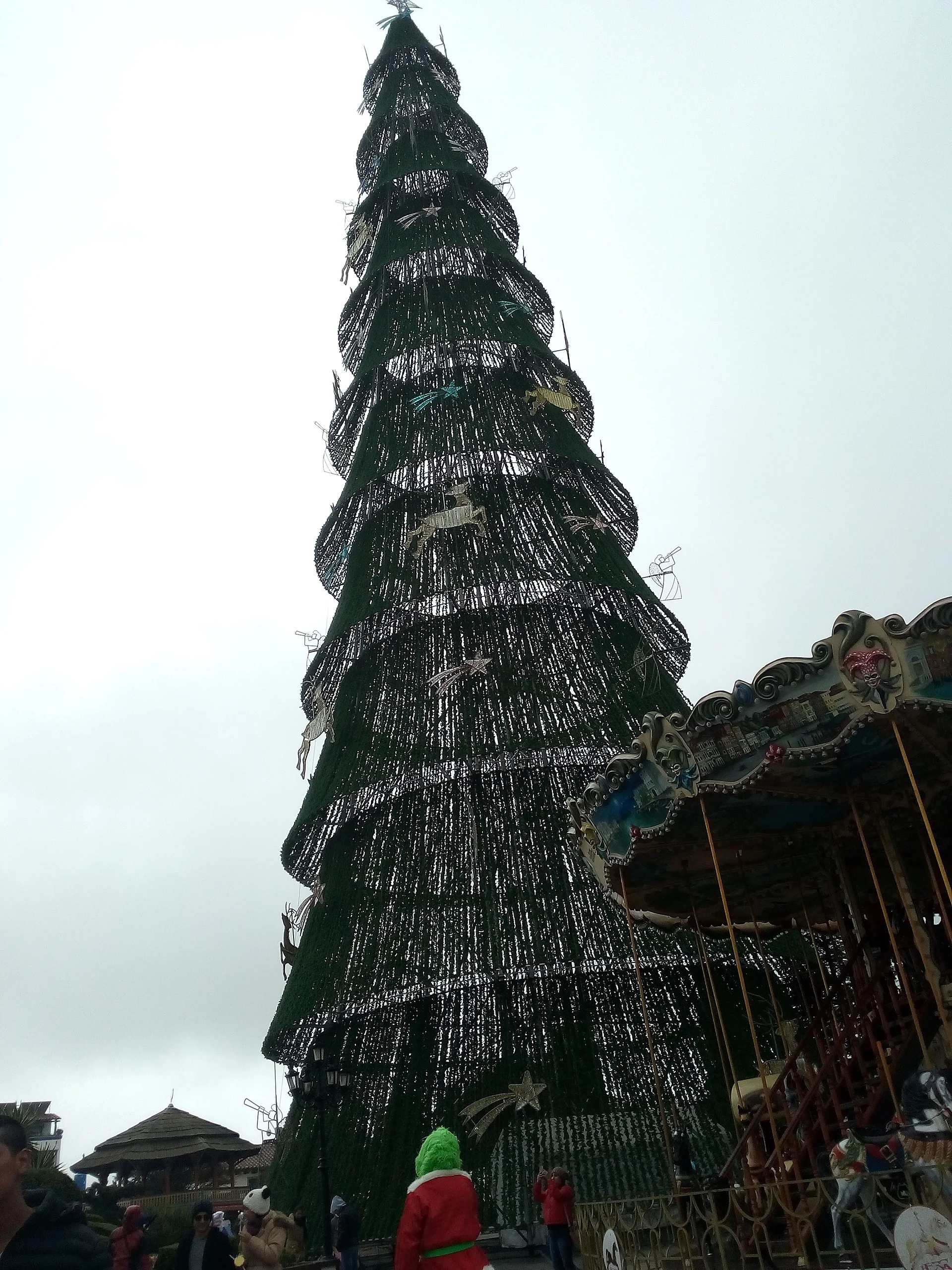
Chignahuapan's monumental Christmas tree, a cone of lights more than 60 meters tall, rising over the town, Puebla

Photo by Fátima P. Cadena V., CC BY-SA 4.0, via Wikimedia Commons

Nov 20 – 29, 2026

Feria del Árbol y la Esfera 2026 in Chignahuapan, Puebla

Ten days in late November when the ornament town of the Sierra Norte de Puebla holds its big fair: glass esferas straight from the workshops, nightly concerts and a Christmas tree more than 60 meters tall in the main square.

Chignahuapan is a mountain town at about 2,290 meters in the Sierra Norte de Puebla, and for half a century its families have made blown-glass Christmas ornaments. Hundreds of workshops, many of them in people's homes, start producing in February for the season, and the town sells tens of millions of esferas a year. The Feria Nacional del Árbol y la Esfera, lately also billed as international, is the high point: ten days of ornament stalls, food, a fair queen and concerts.

The 2026 fair runs from Friday November 20 to Sunday November 29. The season started earlier: the monumental tree and sphere were lit in the zócalo on October 24, and a Christmas parade is announced for December 4. As of late October the concert lineup and ticket prices had not been published. Nights are cold and often foggy; bring a warm jacket, and pair the trip with the hot springs and Zacatlán next door.

How the esferas are made

A glass sphere being dipped into blue paint in a Chignahuapan workshop
Photo by Micaela Imelda, CC BY-SA 4.0, via Wikimedia Commons

Chignahuapan's ornaments are blown glass decorated by hand. A glass tube is heated in a torch flame and blown into a sphere, which is then silvered inside so it shines, dipped in paint or lacquer, and finished with glitter, painted scenes, names and figures. Production starts in February so that the stock is ready by autumn, and counts of the town's workshops run from more than 200 to more than 400, from family rooms with a single burner to small factories.

Many shops in the center have a workshop at the back or can send you to one, and visitors can often watch the blowing and painting. The busiest weeks for the makers are the ones just before and during the fair, so go in the morning, when they are working rather than selling.

Buying esferas

Shoppers in front of a Chignahuapan ornament shop whose walls are covered with esferas
Photo by Isaacvp, CC BY-SA 4.0, via Wikimedia Commons

The ornament shops cluster around the center and along the roads into town, and many sell straight from the makers, from boxes of plain spheres to large hand-painted pieces, crowns, stars, felt figures, decorative trees and nativity sets. Prices drop when you buy by the box or the dozen, and shops will usually paint a name on a sphere for you. The town's artisan center and the fair stalls gather many makers in one place, which is handy for comparing.

Come before the fair, in late October or early November, if what you want is to shop in peace: the tree is already lit, the shelves are full and the crowds are smaller. Ask for your pieces wrapped and boxed, and keep the boxes on your lap, not in the trunk, on the mountain roads home.

The fair: stalls, concerts and the fair queen

A seller among boxes and racks of red glass Christmas ornaments in Chignahuapan
Photo by Adan Tun Salazar, CC BY-SA 4.0, via Wikimedia Commons

The fair combines an ornament and craft market, regional food and drink, the crowning of the fair queen and concerts. Some events are free; the big concerts are ticketed. The 2026 fair runs November 20 to 29; as of late October the lineup, venue and prices were still to be announced. For reference, in 2025 the 29th edition ran November 21 to 30 at the town's fairground with a different act each night, and tickets cost from 100 to 2,000 pesos depending on the zone, sold at the tourism offices of Chignahuapan and Zacatlán and online.

Watch the town's tourism channels (Visita Chignahuapan) and the Puebla press for the lineup.

The town in December: the tree, the kiosk and the hot springs

The painted wooden kiosk in Chignahuapan's main square
Photo by Menfis1negro, CC BY 3.0, via Wikimedia Commons

From late October to the end of the season the zócalo is dominated by the monumental Christmas tree, a metal structure more than 60 meters tall wrapped in kilometers of lights, with an elevator to a viewpoint (paid separately; looking from the square is free), and by a giant sphere about 12 meters high. Next to them stand the sixteenth-century parish church of Santiago Apóstol and the early-twentieth-century wooden kiosk, painted in Mudéjar style with a fountain under its roof. The Basílica de la Inmaculada Concepción, a few blocks away, holds a carved cedar Virgin more than 12 meters tall.

By day, the thermal baths in a wooded ravine outside town are the natural way to warm up, the Salto de Quetzalapan waterfall is about 8 km away, and Zacatlán, the apple and clock-making Pueblo Mágico, is next door. In December the town keeps its decorations up through the posadas and Christmas.

Day by day, 2026

  1. Tree and sphere lighting

    The monumental tree and sphere are lit in the zócalo, free to attend, opening the Christmas season.

  2. The fair opens

    Opening day of the Feria del Árbol y la Esfera, with the ornament market and the first night of concerts.

  3. Last day of the fair

    Closing day of the 2026 fair.

  4. Christmas parade

    The Christmas parade is announced for today.

  5. Posadas begin

    The nine nights of posadas start across Mexico, with the tree still lit in the zócalo and the shops open.

Getting there

From Puebla
About 112 to 120 km, a little over two hours by car: take the Puebla–Tlaxcala highway (119D) to Apizaco, then federal 119 north toward Zacatlán and Chignahuapan. ATAH and Supra buses leave Puebla's CAPU several times a day and take about two hours.
From Mexico City
About 190 km, two and a half hours by car: México–Pachuca highway (85D), then 132D toward Tulancingo and on toward Huauchinango, taking the turnoff to Chignahuapan. By bus, check for direct services from Mexico City or connect through Puebla's CAPU. On fair weekends, leave early: the last stretch is a mountain road that backs up.
From Tlaxcala or Pachuca
From Tlaxcala, go to Apizaco and take federal 119 north through Tlaxco; ATAH runs buses from Apizaco. From Pachuca, drive east to Tulancingo; Chignahuapan is about 50 km, roughly an hour, beyond.

Where to stay

Chignahuapan has hotels around the zócalo and by the lagoon, plus cabins in the pine woods around town, many with a fireplace, which you will want at night. Fair weekends, especially the two Saturdays, fill up, so book ahead; weekdays during the fair are easier. Hotels a few blocks from the zócalo let you walk to the tree and the shops, and the hot-spring spa has its own hotel down in the ravine.

If the town is full, Zacatlán, the neighboring Pueblo Mágico, has hotels and cabins a short drive away; just avoid driving the sierra roads late at night in fog. From Puebla the trip also works as a long day out.

Photo by Danielllerandi, CC BY-SA 3.0, via Wikimedia Commons

Sierra Norte de Puebla

Chignahuapan

Come for two nights: one day for the workshops and shops around the center and the artisan center, an evening at the fair and its concert, and a morning at the hot springs before heading home. The giant tree and sphere in the zócalo are lit from late October, so the shopping season runs well beyond the fair itself.

When
Fair November 20 to 29, 2026; tree lit since October 24; Christmas parade December 4.
Getting there
Two hours from Puebla (ATAH or Supra from the CAPU); two and a half from Mexico City by car via Pachuca and Tulancingo.
Where to stay
SYMER Hotel · 640 m from the center Find on Expedia 9 Manantiales Hotel · 1.4 km from the center Find on Expedia
See them all on Expedia Booking.com
Vacation rentals on Vrbo Airbnb
Tours on Viator GetYourGuide

Full guide to Chignahuapan → · Sources: Anuncian la Feria del Árbol y la Esfera 2026 (El Universal Puebla, October 1, 2026) , Chignahuapan (Wikipedia, in Spanish)

Photo by AlejandroLinaresGarcia, CC BY-SA 3.0, via Wikimedia Commons

Sierra Norte de Puebla, next to Chignahuapan

Zacatlán

The overflow base and the best half-day trip. See the two-faced flower clock in the main square and the Relojes Centenario clock museum, buy apple cider and fruit wines, and drive out to the Valle de Piedras Encimadas or the San Pedro waterfall. Its tourism office has also sold tickets for the Chignahuapan fair's concerts.

When
Any day of the fair; the fair itself is in Chignahuapan.
Getting there
Zacatlán and Chignahuapan are neighboring towns on the same sierra road, a short drive apart.
Where to stay
Hotel Casa Quiroz Hotel · 50 m from the center Find on Expedia Casa San Miguel Hotel · 110 m from the center Find on Expedia Hotel Zacatlán Hotel · 160 m from the center Find on Expedia
See them all on Expedia Booking.com
Vacation rentals on Vrbo Airbnb
Tours on Viator GetYourGuide

Full guide to Zacatlán → · Sources: Zacatlán (Wikipedia)

Places to see nearby

  • Aguas Termales de Chignahuapan · near Chignahuapan Long-running hot-spring resort in a ravine east of town, with warm thermal pools, a spa and rooms for an overnight soak.
  • Salto de Quetzalapan · near Chignahuapan Chignahuapan's big waterfall, a drop of around 200 meters reached by a long stone staircase, with zip lines and rappelling.
  • Valle de Piedras Encimadas · near Zacatlán A pine-forest valley of huge stacked volcanic rocks shaped like towers and faces; cabins, horses and camping on site.
  • Cascadas de Tulimán · near Zacatlán Ejido-run park on the same river as Quetzalapan: a roughly 300-meter fall in three drops, a warm mineral pool and hanging bridges.
  • Aquixtla · near Chignahuapan Quiet sierra town on the road to Tetela, with two turquoise waterfalls, Tepexcanal and Popocaya, in its hills.
  • Cascada de San Pedro · near Zacatlán The closest waterfall to Zacatlán, a graceful drop of about 20 meters in a wooded ravine on the edge of town.

Etiquette

Many workshops are part of family homes. Ask before you photograph people at work, do not touch the burners or hot glass, and keep children's hands off the racks. If someone takes the time to show you the blowing or painting, buying a few pieces is the polite thanks. Handle glass by the cap and pay for anything you break.

Bargain gently, mostly by buying in quantity, and carry cash for small shops and stalls. For concerts, buy tickets through official outlets only (the town's tourism offices or the ticket site it names) and arrive early. Dress for 2,300 meters in late November: a warm jacket and a hat for nights at the fair.

Questions

When is the Feria del Árbol y la Esfera in Chignahuapan?

From Friday November 20 to Sunday November 29, 2026. The tree and sphere in the zócalo were lit on October 24, and the Christmas parade is on December 4.

Is the fair free?

Walking the ornament stalls and some events are free; the main concerts are ticketed. In 2025 concert tickets cost from 100 to 2,000 pesos depending on the zone.

How big is the Christmas tree?

More than 60 meters: a metal structure wrapped in about 20 km of garland and lights, with an elevator to a viewpoint that costs extra. In 2023 it measured 65 meters, or 67 with the star. Next to it stands a giant sphere about 12 meters high.

Can I visit the esfera workshops?

Yes. Many shops in the center have a workshop on site or nearby where you can watch the glass being blown and painted. Mornings are best, before the makers turn to selling.

Chignahuapan or Tlalpujahua?

Both are ornament towns. Chignahuapan's fair is ten days in late November, with concerts, and pairs with hot springs and Zacatlán; it is closest to Puebla and eastern Mexico City. Tlalpujahua's fair runs from October to mid-December and pairs with El Oro and the monarch butterflies; it is closer to Morelia and Querétaro.

Sources

More Day of the Dead guides

Christmas posadas 2026 in Mexico's Pueblos Mágicos Tepotzotlán pastorelas Tlalpujahua's Feria de la Esfera Noche de Rábanos (Oaxaca) Posadas dates Near Mexico City

Links open a partner site. We may earn a commission if you book, at no cost to you. See festivals in every Pueblo Mágico, month by month →