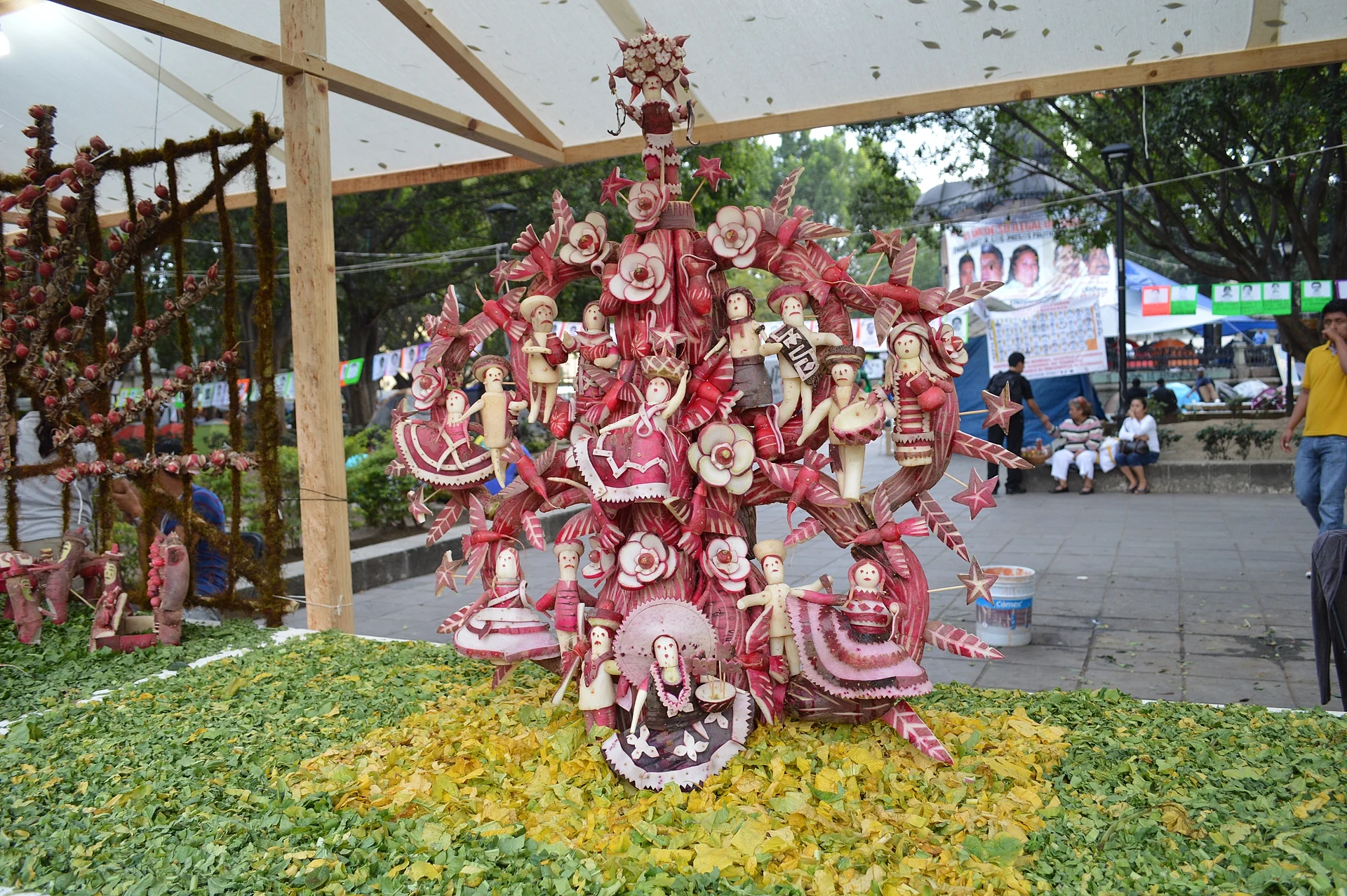
The Noche de Rábanos is a contest that the city of Oaxaca has held on December 23 since 1897. Growers and artisans carve oversized radishes into nativity scenes, dancers, saints, mezcal stills and whole village festivals, set them out on stands in the zócalo, and the city judges them the same evening. Two other materials have their own categories: totomoxtle, dried corn husk, and flor inmortal, a dried flower that keeps its color. By the end of the night the radishes are already going soft, which is why the whole thing happens in a few hours.
It falls in the middle of Oaxaca's busiest week of the year. The posadas start on December 16, the city's patron, the Virgen de la Soledad, has her feast on December 18, and on the night of December 24 the neighborhood churches send their calendas to the zócalo. In 2026, December 23 is a Wednesday, and it would be the contest's 129th edition (the 2025 one was the 128th); as of November 1 the city had not yet published its program.
This page covers what you will see, how the lines and the judging work, the days around it, how to get to Oaxaca, and where to stay in a week when rooms go early.
The radishes are not ordinary ones. The city grows them for the contest on municipal plots at the Parque El Tequio, left in the ground long after a normal harvest and heavily fertilized until they twist into odd shapes; they can grow to half a meter long and weigh up to 3 kg. The town hall hands them out free to registered contestants a few days before. In recent years it has also held a public harvest day at the El Tequio plots: in 2025 it was on December 20, with free transport leaving Parque Juárez El Llano at 6:45 am.
The radish entries are judged in five categories: Tradicional (Oaxacan customs and nativity scenes, the one with the biggest prize), Libre (open themes, created for newer styles and art students), Juvenil (ages 13 to 17) and two children's categories, 6 to 8 and 9 to 12. Totomoxtle has a Natural category, where the only color allowed is the husk's own, and a Decorada one; flor inmortal is a single category. In 2025 the city showed 137 works and the winners ranged from the Diablos dance of Juxtlahuaca carved in radish to a corn husk festival of the moles of Oaxaca's eight regions and a flor inmortal Soledad procession. Prize money changes by year; press reported top prizes of up to 30,000 pesos in 2025.
The lines, the judging and the evening in the zócalo
Contestants spend the morning and early afternoon of December 23 carving and assembling their scenes on the stands, because a cut radish only lasts a few hours. In 2025 the exhibition opened to the public at 3 pm and ran until 9 pm; older guides give 5 pm, so check the city's program for the year. Visitors walk past the stands in a line, and the city has used a two-line setup with one line on a raised walkway; at the busiest moments the wait has been reported at four to five hours. The judges go round during the afternoon and the prizes are given around 9 pm, after which the works are taken down.
The rest of the zócalo turns into a fair: stalls of regional sweets, nieves, mezcal and buñuelos, the fried wheat fritters in syrup that are served on cheap clay plates which people then smash for luck. In 2025 the Grupo Folklórico de Oaxaca staged a piece about growing and harvesting radishes at 4 pm. The state has also added a parade with floats and brass bands the evening before, on December 22, since 2023; in 2025 it left the Fuente de las Ocho Regiones at 6 pm, followed by a free concert in the Alameda de León. The first one, in 2023, was marred when a stand of bleachers in front of the cathedral collapsed and injured 13 people.
The two newer categories are worth slowing down for, because unlike the radishes they are built over weeks and hold their detail. Totomoxtle pieces are made from dried corn husk, cut, folded and sometimes dyed into tiny dancers, market women, churches and whole calendas; in the Natural category the maker can only use the husk's own creams and browns. Flor inmortal scenes are made from a small dried flower grown in the Central Valleys around Ocotlán, which keeps its color, so these are the brightest stands in the square. Both often show the same subjects as the radishes: the Guelaguetza, the Soledad, Juquila, posadas, the weaving towns of the valley.
The custom comes from the colonial Christmas Eve market in the main square, where farmers sold vegetables, herbs, flowers and dried fish for the Christmas dinner, and some carved their radishes into figures to draw buyers. In 1897 the mayor, Francisco Vasconcelos, turned it into a formal contest to encourage the city's market gardeners, and it has been held every year since. As the city spread over the farmland along the Atoyac river, fewer families grew radishes, which is why the town hall now grows and hands them out, and why many contestants describe themselves as radish artisans rather than growers. Many come from the same families year after year, and from nearby valley towns.
Five days before the radishes, the city celebrates its patron, the Virgen de la Soledad, at her basilica, a few blocks west of the zócalo. By legend the image arrived in 1617 in a box on a mule that collapsed outside the hermitage of San Sebastián, where the basilica now stands. A novena leads up to the feast, with masses, bands, fireworks and women in regional dress. On the evening of December 17 a convite goes round the homes of the year's sponsors and returns to the church after midnight; at midnight the first mass is said and the mañanitas are sung, a rosary goes through the streets at 4 am, and masses follow through the day on the 18th. Pilgrims line up to pass beneath the Virgin's mantle, and the atrium and the Plaza de la Danza next door fill with dancers and food stalls.
The night after the radishes closes the posadas. On December 24 the churches of the center and the old neighborhoods each send out a calenda with the Christ Child, carried by its godparents: floats, paper lanterns, a brass band and the neighbors walking behind, with children often at the center of it. They leave their churches around 8 pm and converge on the zócalo and the cathedral around 10 pm, circle the square, and go back for midnight mass. It is free and loud, and the best place to see several calendas pass is the edge of the zócalo or the Alameda de León by the cathedral.
Day by day, 2026
The posadas begin
Nine nights of posadas start in the neighborhood churches, with processions, ponche and piñatas; San Matías Jalatlaco is a good one to look for, from around 6:30 pm. The Soledad novena is already under way.
Feast of the Virgen de la Soledad
The convite goes out the evening before, the mañanitas are sung at midnight and masses run all day at the basilica, with dancers and food stalls in the atrium and the Plaza de la Danza.
Noche de Rábanos in the zócalo
Carving in the morning, the exhibition from mid-afternoon (3 pm in 2025), prizes around 9 pm. Get in line early.
Calendas of Christmas Eve
Each church's calenda with the Christ Child sets out around 8 pm and reaches the zócalo and cathedral around 10 pm, before midnight mass.
Getting there
From Mexico City
The fastest way is to fly: Aeroméxico, Viva and Volaris fly from Mexico City's AICM to Oaxaca airport (OAX), about an hour, and Aeroméxico Connect and Viva also fly from AIFA. By bus, ADO and other first-class lines run from TAPO and other terminals to Oaxaca's first-class station in about six and a half to seven hours. Driving takes five to six hours on the toll road via Puebla and the Cuacnopalan–Oaxaca autopista (135D). Book early: this is a peak week for both flights and buses.
From Oaxaca airport
The airport is in Santa Cruz Xoxocotlán, a southern suburb of the city, a short taxi ride from the center. On December 23 the blocks around the zócalo are packed, so get dropped a few streets away and walk in.
From Guadalajara, Monterrey, Tijuana or the US
There are direct flights to Oaxaca from Guadalajara (Volaris), Monterrey (Viva) and Tijuana (Viva and Volaris), and from Dallas/Fort Worth (American), Houston (United) and Los Angeles (Volaris). Otherwise connect through Mexico City.
Where to stay
Stay in the center of Oaxaca city, within walking distance of the zócalo: the radishes, the Soledad, the posadas and the calendas all happen on foot within a few blocks, and you will want to get back to your room between the line and the evening. Jalatlaco and the streets around Santo Domingo are the usual choices. Book well ahead; for the 2025 edition the state projected hotel occupancy of about 69 percent for the night alone, inside a holiday season that runs from mid-December into January.
If the center is full or you want quiet nights, Mitla, about 45 km east on Highway 190, has small hotels near the ruins and its own December festivities; it works best with a car or a taxi back after the prizes.
The Pueblo Mágico nearest to the radishes keeps its own Christmas season: Mitla has held festivities from around mid-December into early January, with a decorated main square, local bands at night and, in recent years, an ice rink. Pair a day there with the Zapotec palaces, the Tule tree and the weaving town of Teotitlán del Valle on the way, and sleep there if the city is full.
When
From around mid-December into early January; there is no published program.
Getting there
About 40 minutes to an hour from Oaxaca city on Highway 190, by colectivo, second-class bus or taxi.
Árbol del Tule· near Mitla
A Montezuma cypress in Santa María del Tule with one of the widest trunks in the world, on the road between Oaxaca and Mitla.
Teotitlán del Valle· near Mitla
The Zapotec weaving village of the valley: family workshops making wool rugs on foot looms with natural dyes.
Tlacolula· near Mitla
Home of one of Oaxaca's oldest and biggest Sunday markets, and a Baroque chapel covered in gilded plasterwork.
Hierve el Agua· near Mitla
Mineral springs that have built white rock "waterfalls" down a cliff, with pools to swim in and huge views of the sierra.
Etiquette
Join the line at its end and stay in it; cutting in is the fastest way to make the people around you angry after a three-hour wait. Do not touch the works or lean on the stands: the radishes bruise and the corn husk and dried flower pieces break, and contestants watch over them all day. Photos are fine, but keep moving so the line keeps moving, and do not use flash in people's faces at night. The square is packed, so keep your phone and wallet in front, agree on a meeting point, and bring cash for the stalls. December evenings in Oaxaca are cool once the sun goes down, so bring a layer, and comfortable shoes for a long stand on stone. At the Soledad and the calendas, these are religious feasts: give way to processions, and keep quiet near the masses.
Questions
When is the Noche de Rábanos in 2026?
Always on December 23, a Wednesday in 2026, in the zócalo of Oaxaca city. In 2025 the exhibition was open from 3 pm to 9 pm, with the prizes given around 9 pm; check the town hall's program for this year's times.
Does it cost anything to see the radishes?
No. The exhibition in the zócalo is free, as are the parade the evening before and the calendas on December 24. What it costs is time: the line has been reported at four to five hours at its peak.
What is the best time to go?
Early. The radishes look their best right after the exhibition opens, before they start to wilt, and the line is shortest then. Come back near 9 pm if you want to see the prizes, when the square is at its fullest.
What are totomoxtle and flor inmortal?
Totomoxtle is dried corn husk, cut and folded into figures; flor inmortal is a small dried flower from the Central Valleys that keeps its color. Each has its own category in the contest, shown next to the radishes.
What else is on in Oaxaca that week?
Posadas every night from December 16, the feast of the Virgen de la Soledad on December 18, a parade of floats the evening of the 22nd in recent years, and the calendas of Christmas Eve on the 24th, which reach the zócalo around 10 pm.
Sources
Facts checked against these pages in November 2026. Programs change each year, so confirm dates with the town before you travel.