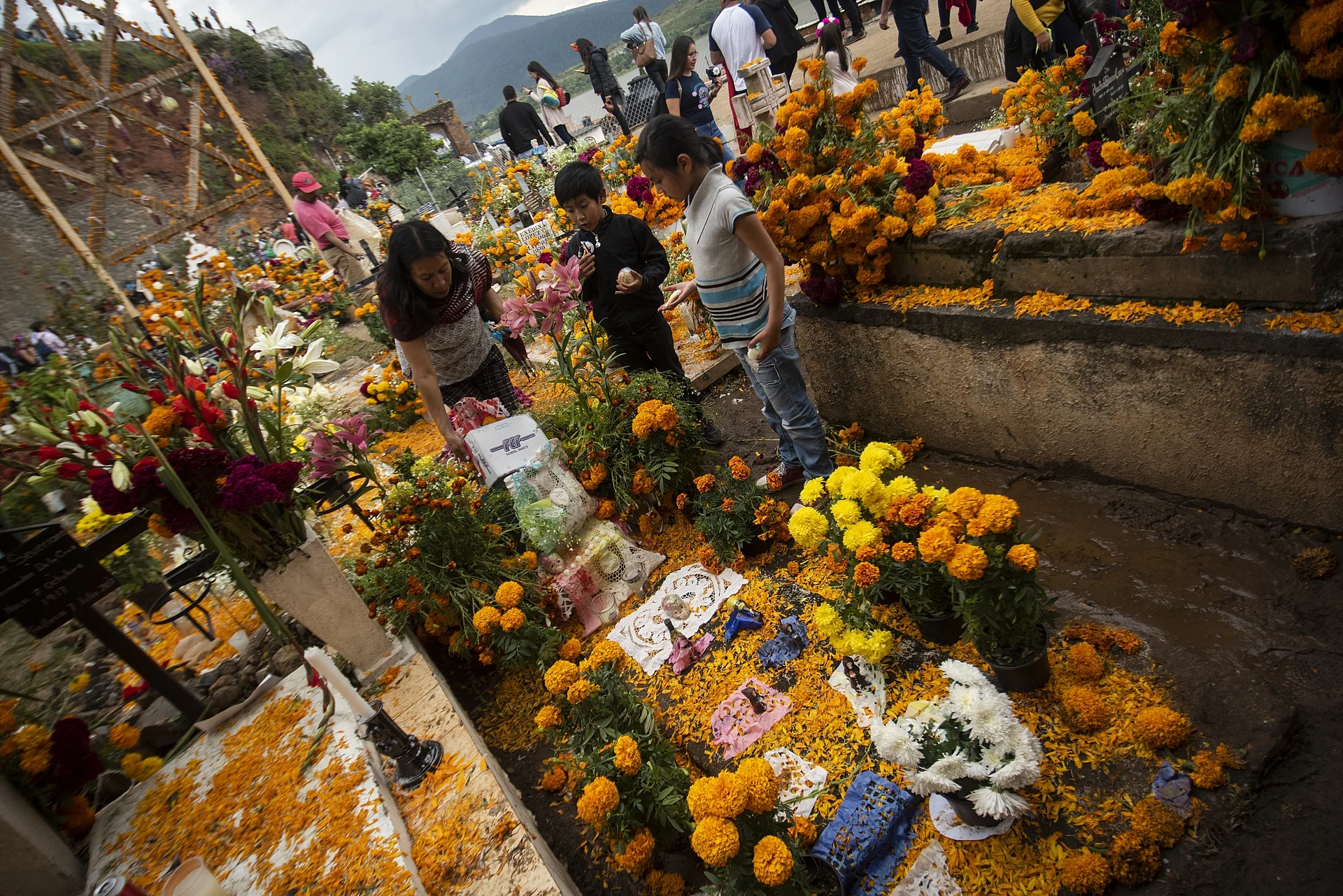
Families decorating graves with cempasúchil marigolds in the Janitzio cemetery on Day of the Dead, Pátzcuaro, Michoacán

Photo by EfrenDelRosal, CC BY-SA 4.0, via Wikimedia Commons

Oct 31 – Nov 2, 2026

Día de Muertos 2026 in Pátzcuaro and Janitzio

The Noche de Muertos around Lake Pátzcuaro, village by village: when to be where, how the boats to Janitzio work, and what the town itself puts on in the days before.

Remind me before Día de Muertos: Pátzcuaro & Janitzio

Around Lake Pátzcuaro, the Purépecha call it Animecha Kejtzitakua, the offering to the souls. On the night of November 1, in some 25 cemeteries on the shore and on the islands, families sit beside graves covered in cempasúchil, candles and the food their dead liked best, praying and keeping watch until dawn. Janitzio is the famous one, but the same vigil happens in Tzintzuntzan, Ihuatzio, Jarácuaro, Arócutin, Tzurumútaro, Cucuchucho and on the smaller islands of Yunuén, La Pacanda and Urandén. The indigenous festivities dedicated to the dead were proclaimed by UNESCO in 2003 as a Masterpiece of the Oral and Intangible Heritage of Humanity.

Pátzcuaro, the colonial town on the south shore, is the base for all of it. In 2026 its main square holds the Tianguis Artesanal de Noche de Muertos from October 24 to November 3, and the 57th state crafts competition is judged from October 26 to November 1. The state's third Semana de Celebración de Noche de Muertos runs from October 23 to November 2, and the Pátzcuaro region alone has 220 activities in 32 venues on the official calendar. The 2026 dates fall on a weekend: October 31 is a Saturday, November 1 a Sunday and November 2 a Monday, which means more visitors than usual. Expect the lake to be at its fullest on the night of Saturday to Sunday and on the Sunday night itself.

It is also a lot of people: the state counted more than 300,000 visitors around the lake on the nights of November 1 and 2 in recent years and expects more than a million across Michoacán's whole season in 2026. Hotels in Pátzcuaro run at 100 percent and most visitors end up sleeping in Morelia. Plan the night, pick one or two cemeteries rather than five, and dress for the cold.

The vigil on Janitzio

A woman keeps vigil by candlelight beside portraits of her dead on a grave in Janitzio
Photo by Gabriel Gutierrez, CC BY-SA 4.0, via Wikimedia Commons

Janitzio is the largest of the lake's islands, a cone of stone houses with about 2,350 people, topped by a 40-meter statue of Morelos you can climb inside. Its cemetery sits on a terrace above the water, and on the night of November 1 the families of the island fill it: arches of cempasúchil over the graves, embroidered cloths, candles, bread and fruit, and the bell at the cemetery gate tolling through the night. Thousands of visitors watch from the paths around it and from the boats below.

The island is only reached by boat. Lanchas leave from the piers on the Pátzcuaro shore, the Muelle General, San Pedrito and Las Garzas, and take about 25 minutes. On a normal day they run until early evening; on the days of the festival they run around the clock. The ordinary fare in recent years has been about 70 pesos round trip on the shared boats, with tickets sold at the pier booths, but no official fare for the night has been published, so confirm it at the booth and buy only there. The lines for the boats, and the climb up the steep cobbled lanes, are the hard part of the night: arrive before dark or come back after midnight, and do not wait for the last boat back.

If the crowd is not what you came for, La Pacanda is the quiet island alternative: boats leave from the Ucasanastacua pier, between Cucuchucho and Tzintzuntzan, take about 15 minutes, run day and night, and the community has a small parador where you can stay.

Pátzcuaro: the crafts market, the contest and the basilica

Ceramic catrinas for sale at the Day of the Dead crafts fair in Pátzcuaro
Photo by LBM1948, CC BY-SA 4.0, via Wikimedia Commons

In town, the week belongs to the artisans. In 2026 the Tianguis Artesanal de Noche de Muertos fills the Plaza Vasco de Quiroga from October 24 to November 3 with more than 350 artisans from over 20 communities, and on October 25 at 10:00 about 500 of them parade in traditional dress through the historic center, along Ponce de León, to the plaza. The best sellers are catrinas, copal burners, candelabra and textiles. The artisans' association asks visitors not to haggle, since a single piece can take months, and most stalls now take cards or transfers.

The 57th Concurso Estatal de Artesanías, run by the Casa de las Artesanías de Michoacán, is judged from October 26 to November 1, with a million pesos in prizes spread over 113 awards and more than 1,900 pieces entered. The entries are on show and for sale in the Antiguo Colegio Jesuita from October 31 to November 2, 10:00 to 20:00, where an exhibition on the Noche de Muertos opens on October 22. On November 1 the Orquesta Sinfónica de Michoacán plays in the Basílica de Nuestra Señora de la Salud, the church Vasco de Quiroga built. The state program also lists 17 artisan workshops in Pátzcuaro, Tzintzuntzan, Tzurumútaro, Ihuatzio, Santa Fe de la Laguna, Arócutin and other towns, from cempasúchil flowers to pan de muerto, at roughly 100 to 250 pesos.

Tzintzuntzan: two cemeteries and the old Purépecha capital

A woman lights candles for her family's dead in the Tzintzuntzan municipal cemetery
Photo by José Luis Ramírez López, CC BY-SA 4.0, via Wikimedia Commons

Tzintzuntzan, 17.5 km from Pátzcuaro on the northeast shore, was the capital of the Purépecha state, and the Yácatas, its five round-fronted pyramids, still look down on the town from a hill a kilometer east of the center. On Day of the Dead the vigil happens in two large cemeteries side by side, at the same time, and some of the offerings built over the graves are monumental. Local accounts describe the bells ringing at midnight on October 31 to call the souls of the children, fireworks through that night, and a procession with arches and music at 5 pm. The town's Semana Artístico-Cultural de Noche de Muertos adds a float parade along the lakeshore and craft and cooking contests, atole above all.

Past programs have also staged the Purépecha ball game with a flaming ball near the Yácatas on the evening of November 1; it does not happen every year, so check the municipal program before you plan around it. Crowds in the cemeteries are thinner early in the evening and again after midnight.

Ihuatzio, Jarácuaro, Santa Fe de la Laguna and the quieter shore

The main square of Santa Fe de la Laguna, a Purépecha town on Lake Pátzcuaro
Photo by Hesssika, CC BY 4.0, via Wikimedia Commons

Every village on the shore keeps its own vigil the same night, and several are a short drive or combi ride from Pátzcuaro. Ihuatzio, one of the three early Purépecha seats along with Pátzcuaro and Tzintzuntzan, has its own pre-Hispanic site and a cemetery that fills the night of November 1. In Jarácuaro each barrio raises its own arch of flowers; over the graves around the lake the floral arch, the uatsakurï, is the doorway the dead come back through. Tzurumútaro's community cemetery is right by the road, Cucuchucho and Arócutin are small and calm, and in Arócutin travelers have written of being welcomed at the gate with candied squash and coffee.

Santa Fe de la Laguna, a Purépecha town 3 km from Quiroga and 27 km from Pátzcuaro, does it differently. Families who lost someone in the past year build an ofrenda nueva at home; in 2026 the state program lists the altars going up on October 30, and visitors may go in to see them if they bring a small gift and behave as guests. Its cemetery ceremony is on the afternoon of November 2, from about 2 pm, when families clean and dress the graves and spend the afternoon eating together. At the Urandén springs, the Camino de las Ánimas canoe rides through candlelit channels run on October 23, 24, 25, 30 and 31 and November 1 and 2, 2026, for about 50 pesos plus parking.

Day by day, 2026

  1. Tianguis Artesanal opens in the Plaza Vasco de Quiroga

    More than 350 artisans from over 20 communities set up in Pátzcuaro's main square, open until November 3. The state's Semana de Celebración de Noche de Muertos began the day before.

  2. Artisans' parade

    At 10:00, about 500 artisans in traditional dress parade through the historic center, along Ponce de León, to the Plaza Vasco de Quiroga.

  3. State crafts contest is judged

    The 57th Concurso Estatal de Artesanías is judged from today to November 1: 113 prizes and a million pesos in all.

  4. The first souls arrive

    In Purépecha tradition, October 28 is when the souls of those who died suddenly or violently return. It is also the start of the central week of the 2026 state program, when the biggest events are concentrated.

  5. Graves and altars get ready

    Families finish cleaning and repairing graves and building arches. In Santa Fe de la Laguna the ofrendas nuevas go up in the homes of those who lost someone this year. Hotels around the lake start to fill from today.

  6. The children's souls are called

    The crafts contest entries go on show and on sale in the Antiguo Colegio Jesuita, 10:00 to 20:00, through November 2. At midnight in Tzintzuntzan, the bells ring to call the angelitos, the souls of children.

  7. Angelitos by day, the great vigil by night

    The velación de los angelitos, for children who died, comes first, in the early hours and morning. In the evening the Orquesta Sinfónica de Michoacán plays in Pátzcuaro's basilica and the crafts contest closes. At nightfall the candles go on in the cemeteries of Janitzio, Tzintzuntzan and the lake villages, and families keep vigil until dawn.

  8. Dawn on the lake, Santa Fe in the afternoon

    The vigil ends at first light. In Santa Fe de la Laguna the cemetery fills from about 2 pm. Last day of the state's Semana de Celebración and of the crafts contest exhibition; the tianguis stays until November 3.

Getting there

From Mexico City
About 356 km. By car, take the México–Toluca–Guadalajara toll road (15D) to Morelia, then the Morelia–Uruapan highway to Pátzcuaro; allow about four and a half hours without traffic. By bus, Autovías serves Pátzcuaro from Mexico City; round trips cost roughly 800 to 1,500 pesos in season. Buy online well before October 31.
From Morelia
Pátzcuaro is about 55 km away, roughly an hour on the four-lane highway toward Uruapan. Buses leave all day from Morelia's bus station. Morelia is where most visitors sleep, so expect traffic on the road back after midnight on November 1.
From Guadalajara
Roughly 250 km and a little over three hours by car on the Guadalajara–Morelia toll road (15D), turning south toward the lake. By bus it is usually quicker to ride to Morelia or Uruapan and change there.
From Querétaro
Drive west to Morelia on the toll roads through Celaya and Salamanca, then an hour on to Pátzcuaro. By bus, Autovías includes Querétaro in its network; plan on changing in Morelia.
Flying in
Morelia's airport (MLM) has the most flights, with Volaris and Aeroméxico to Mexico City, Tijuana, Monterrey, Cancún and several US cities; from there it is about an hour to Pátzcuaro. Uruapan (UPN), with Volaris flights from Tijuana and Los Angeles among others, is about 60 km away on the 14D toll road.

Where to stay

Sleep in Pátzcuaro if you can: it puts you a short walk or taxi from the piers, and you can come back from the cemeteries at 3 am without a long drive. Hotels in town have been at 100 percent on the big nights in recent years, so if you are booking late, look at the lake towns (Tzintzuntzan has only a handful of rooms) or go to Morelia, an hour away, which has by far the most beds and is where most visitors have stayed in recent years. Uruapan is the other fallback and holds its own Festival de las Velas in the days before November 1. Mid-range rooms in Pátzcuaro cost roughly 500 to 1,500 pesos in normal times and rise for these dates. If you stay outside Pátzcuaro and drive, decide in advance who stays sober and where you will park, because the roads to the piers and to Tzintzuntzan jam on the night of November 1.

Photo by NopalTropical, CC BY-SA 4.0, via Wikimedia Commons

Lake Pátzcuaro, Michoacán

Pátzcuaro

The natural base for the lake. From the colonial center you can walk to the crafts market in the Plaza Vasco de Quiroga, take a short taxi to the piers for Janitzio, and reach Tzintzuntzan, Ihuatzio or Jarácuaro in about half an hour or less by car or combi. The town has the most restaurants and rooms on the lake, but they go first: on the nights of November 1 and 2 it has run at 100 percent in recent years. Staying here means you can do the cemeteries late, sleep, and catch the Santa Fe de la Laguna afternoon on November 2.

When
Tianguis Artesanal October 24 to November 3, 2026; vigils the night of November 1 into November 2.
Getting there
About an hour from Morelia and four and a half hours from Mexico City by car; Autovías buses from both.
Where to stay
Hotel Mision Patzcuaro Centro Historico Hotel · 130 m from the center Find on Expedia Hotel Los Escudos Hotel · 280 m from the center Find on Expedia Hotel Casa Báez Hotel · 300 m from the center Find on Expedia
See them all on Expedia Booking.com
Vacation rentals on Vrbo Airbnb
Tours on Viator GetYourGuide

Full guide to Pátzcuaro → · Sources: Pátzcuaro (Wikipedia) , Día de Muertos en Pátzcuaro (México Desconocido) , Más de 500 artesanos participarán en desfile de Noche de Muertos en Pátzcuaro (MiMorelia, 2026)

Photo by Mario guerrero ledesma 1, CC BY-SA 3.0, via Wikimedia Commons

Lake Pátzcuaro, Michoacán

Tzintzuntzan

Seventeen kilometers up the shore, the old Purépecha capital is the best second stop of the night and the place to be at midnight on October 31, when the bells call the children's souls. Its two cemeteries keep vigil side by side on November 1, the Yácatas and the 16th-century Franciscan monastery with its olive-tree atrium are a short walk apart, and it is the place to buy pottery straight from the potters. Rooms in town are few; most people come for the evening from Pátzcuaro or Morelia.

When
Bells at midnight on October 31; cemetery vigil from nightfall on November 1 to the morning of November 2.
Getting there
About 30 minutes from Pátzcuaro by car or combi along the road to Quiroga; about an hour from Morelia.
Where to stay
Hotel Colibri Hotel · 820 m from the center Find on Expedia Hotel Colibri 250 mxn Hotel · 820 m from the center Find on Expedia Hotel Boutique Hacienda Ucazanaztacua Hotel · 6.0 km from the center Find on Expedia
See them all on Expedia Booking.com
Vacation rentals on Vrbo Airbnb
Tours on Viator GetYourGuide

Full guide to Tzintzuntzan → · Sources: Tzintzuntzan, Michoacán (Wikipedia) , 3 Pueblitos mágicos para visitar en Michoacán en este Día de Muertos 2025 (Tus Buenas Noticias)

Places to see nearby

  • Isla de Janitzio · near Pátzcuaro The lake's best-known island, crowned by a giant Morelos statue you can climb inside, a short boat ride from Pátzcuaro's pier.
  • Isla Yunuén · near Tzintzuntzan A small, green and quiet island in the north of the lake, a calmer alternative to Janitzio by boat from Pátzcuaro.
  • Isla La Pacanda · near Tzintzuntzan A round, farming island in the middle of the lake with an inner lagoon and a famous Day of the Dead, with altars open in homes.
  • Zona Arqueológica de Ihuatzio · near Pátzcuaro One of the three Purépecha capitals: rectangular pyramids and raised stone causeways on a hill above the lake.
  • Jarácuaro · near Pátzcuaro A former island of hat weavers, often called the birthplace of the Danza de los Viejitos, with a lively Day of the Dead night.
  • Santa Fe de la Laguna · near Tzintzuntzan A Purépecha potters' village founded by Vasco de Quiroga in 1533, whose church helped inspire Pixar's Coco.

Etiquette

You are a guest at a family's vigil. Keep your voice low in the cemeteries, walk on the paths and never on or across graves, and do not move offerings or candles. Ask before photographing people, and turn off your flash: a burst of light in a candlelit cemetery is the fastest way to be unwelcome. Leave tripods and drones at home; there is no room for them between the graves.

The lake sits at 2,140 meters and the nights are cold, often damp, with light rain in some years: bring a warm jacket, a hat and shoes for steep, wet cobbles. Carry cash for boats, atole and bread. In Santa Fe de la Laguna, if a family invites you in to see an ofrenda nueva, bring something small for the altar, such as candles, fruit or bread. At the crafts market, pay the price asked; the artisans' association asks visitors not to haggle. On the boats, keep your seat, follow the boatmen's instructions and buy tickets only at the official booths.

Questions

What time should I go to Janitzio?

The vigil begins at nightfall on November 1 and lasts until dawn on November 2, and the boats run around the clock on those days. The lines build up as night falls. Either cross before dark, see the island as the candles go on and come back before the rush, or go after midnight, when it is quieter and colder. Do not wait for the last boat back.

How much is the boat to Janitzio?

The usual fare in recent years has been about 70 pesos round trip per person on the shared boats from the Muelle General or San Pedrito, about 25 minutes each way. No official fare for the Noche de Muertos 2026 has been published, and it can change for the festival, so check the price at the pier's ticket booth and buy only there, not from anyone offering a boat on the street.

Is it safe to go to Pátzcuaro for Day of the Dead?

The festival itself is heavily policed: in recent years the state deployed more than 1,500 officers with the National Guard around the lake and reported no serious incidents. Foreign governments are cautious about Michoacán as a whole. The UK advises against all but essential travel to the state except Morelia, the town of Pátzcuaro reached by the toll roads from Morelia, and boat trips to the lake's islands; the US rates Michoacán "Do Not Travel". Travel by day on the toll roads, stick to the festival towns and check the current advisories before you go.

Should I take a tour or go on my own?

On your own is easy if you sleep in Pátzcuaro: walk or taxi to the pier, take a combi to Tzintzuntzan, and set your own hours. Tours from Morelia or Mexico City, from about 2,000 pesos from the capital, make sense if you have no room in Pátzcuaro and do not want to drive the lake roads at night, since parking and traffic are the hardest part. The trade-off is a fixed schedule, usually Janitzio at its busiest.

Is it free?

Yes, the vigils, the cemeteries and the crafts market are free. You pay for the boat to Janitzio, parking, food, and a few organized activities: the canoe rides at Urandén cost about 50 pesos and the artisan workshops roughly 100 to 250 pesos.

Janitzio or Tzintzuntzan?

If you can, both, on different evenings or one after the other. Janitzio has the setting, the boat ride and the crowds. Tzintzuntzan is reached by road, has two large cemeteries with monumental offerings and feels more like a village night, especially early in the evening or after midnight. For something quieter still, try Ihuatzio, Arócutin, Cucuchucho or the island of La Pacanda.

How cold is it at night?

Cold. Pátzcuaro is at 2,140 meters, the small hours by the lake are the coldest of the night, and some years bring rain too: the 2023 vigil was held in light rain and intense cold. Dress in layers, with a warm jacket, hat and gloves, and bring something to sit on if you plan to stay in a cemetery for hours.
Sources

Facts checked against these pages in October 2026. Programs change each year, so confirm dates with the town before you travel.

More Day of the Dead guides

Día de Muertos 2026 in Mexico's Pueblos Mágicos Huaquechula & Atlixco Oaxaca & Mitla Mixquic (Mexico City) Chignahuapan Xantolo, Huasteca Potosina Hanal Pixán, Yucatán Naolinco & La Cantada Ninín in Papantla Tacámbaro Day of the Dead dates Near Mexico City Near Guadalajara Near Monterrey

Links open a partner site. We may earn a commission if you book, at no cost to you. See festivals in every Pueblo Mágico, month by month →