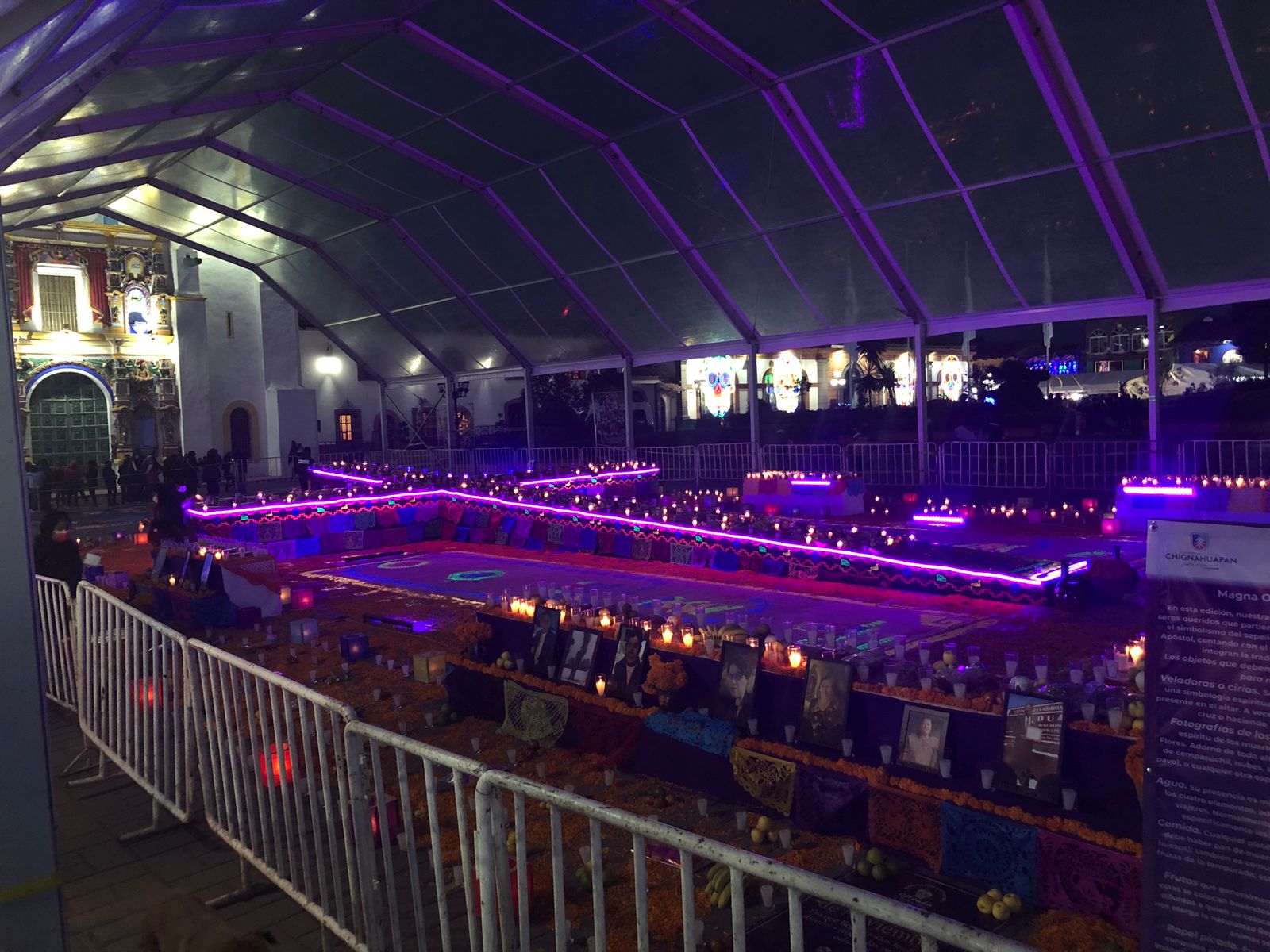
The Ofrenda de las Mil Luces, a giant candlelit altar in Chignahuapan's main square, beside the parish church of Santiago Apóstol, Puebla

Photo by Ricardo.Arath.Diaz.Parra, CC BY-SA 4.0, via Wikimedia Commons

Oct 30 – Nov 2, 2026

Día de Muertos 2026 in Chignahuapan: the Festival de la Luz y de la Vida

A torch-lit walk from the main square to the lagoon, then a show of light, dance and fire on the water that retells the soul's journey to Mictlán. Here is how the nights work, what tickets cost and how to get there.

Remind me before Día de Muertos: Chignahuapan

Most of Mexico keeps the Day of the Dead at home and in the cemetery. Chignahuapan, a mountain town of the Sierra Norte de Puebla at about 2,290 meters, also puts it on stage. For three decades its Festival de la Luz y de la Vida has turned the lagoon at the edge of town into a theater: an illuminated pyramid stands in the water, and actors and dancers act out the nine trials the Nahua believed the dead had to pass on their four-year journey to Mictlán, from the hills that crash together to the river crossed with the help of a dog. Before the show, people walk down from the main square carrying torches, each one standing for a soul.

The festival is ticketed, seated and sells out, which makes it very different from a candlelit cemetery vigil, and it suits families and first-timers. Around it you get a town worth the trip anyway: the blown-glass Christmas ornaments made in hundreds of workshops, a hot-spring spa in a ravine, and Zacatlán, the clock-making and apple town next door. In 2026 the dates fall midweek: October 30 is a Friday and November 2 a Monday. Nights in the sierra are cold and often foggy, so dress for it.

The show on the lagoon

The Festival de la Luz y de la Vida is staged at the Laguna de Chignahuapan, also called Almoloya, a lake fed by nine springs about five minutes from the center. The audience sits around the water facing a pyramid lit from inside, and the performance moves through the nine levels of the underworld as the Florentine Codex tells them: the start of the journey, the hills that crash together, the snake on the road, the green lizard, the eight wastelands, the eight hills, the wind of knives, the river Chiconahuapan and finally Mictlán, the resting place. The water itself is used as a screen for light, and the night ends with fireworks over the lagoon.

2026 is the 30th edition, and it runs four nights: Friday October 30, Saturday October 31, Sunday November 1 and Monday November 2. The town's tourism office describes more than 80 actors and 60 to 65 dancers with live pre-Hispanic music, five stages on the water, a pyramid more than 25 meters tall renovated for the anniversary that doubles as the musicians' stage, and a new seating zone out over the water. As of mid-October the official site still lists the show times as "to be confirmed"; in 2024 the shows started at 7 pm.

The torch walk and the Calzada de las Almas

The festival's opening ritual starts in the main square, beside the sixteenth-century parish church of Santiago Apóstol, where the town builds the Ofrenda de las Mil Luces, a huge altar lit by candles. In 2026 the torch walk sets off from the zócalo at 7 pm on Saturday October 31 and goes down to the lagoon, each torch representing a soul, along the Calzada de las Almas, laid this year with nine carpets, one for each level of Mictlán. It ends at the lagoon where the show begins, so if you have a ticket for that night you can walk with the procession and go straight to your seat.

Tickets and seating zones

Tickets for 2026 are sold only through the official site, festivaldeluzyvida.mx, where sales opened on September 7. You choose the night, then the zone, then numbered seats; the tickets arrive by email as a PDF with a single-use QR code that shows your zone, row, seat and entrance. Official prices per person: zones 1 and 2, nearest the pyramid, 1,500 pesos; zone 3, 900; zones 4, 5 and 6, 1,000; zone 7, at the far side, 400. Every child over three pays, and younger children need a ticket too if they take a seat. Questions go to the sales WhatsApp line, 797 105 4120. Buy the October 31 and November 1 nights first, and bring a blanket: you will be sitting by cold water for a couple of hours.

Esferas: Christmas in October

Shoppers in a Chignahuapan shop hung with hundreds of glass Christmas ornaments
Photo by Isaacvp, CC BY-SA 4.0, via Wikimedia Commons

Chignahuapan's other trade is the blown-glass Christmas ornament. More than 200 workshops make tens of millions of esferas a year, and the shops around the center sell them straight from the makers, many of them happy to show you the blowing, silvering and hand-painting. In 2026 the monumental tree and sphere are lit on October 24, a week before the festival, so the Day of the Dead visit doubles as early Christmas shopping. The Feria del Árbol y la Esfera itself, with concerts and the biggest ornament market, is announced for December 20 to 29, 2026.

By day: the hot springs, the waterfalls and Zacatlán

The thermal spa and hotel of Chignahuapan at the bottom of a forested ravine
Photo by Danielllerandi, CC BY-SA 3.0, via Wikimedia Commons

The festival is at night, which leaves the days free. The thermal baths sit in a wooded ravine about 7 kilometers, or 25 minutes, from the center: the spring rises at about 51 °C and the pools are cooled to between 25 and 38 °C, a good way to warm up after a cold night by the lagoon. The general pools open from 8 am to 5 pm; in October 2026 entry was reported at 150 pesos for adults (about 10 more at weekends and in high season) and 120 for children and INAPAM cardholders. Near town are the Salto de Quetzalapan, a waterfall about 200 meters high, and the Basílica de la Inmaculada Concepción, whose carved cedar Virgin stands more than 12 meters tall.

Zacatlán de las Manzanas, the neighboring Pueblo Mágico to the north, is the natural side trip. It is the home of Relojes Centenario, the clockmakers who built the two-faced flower clock in its main square, five meters across, and whose first public clock went up in 1919 in Chignahuapan's own church of Santiago. The factory has a clock museum. About 25 kilometers beyond, toward Camotepec, is the Valle de Piedras Encimadas, a valley of giant stacked rocks shaped by erosion.

Day by day, 2026

  1. Tree and sphere lighting

    The monumental tree and sphere are lit in the center, opening the season a week before the festival.

  2. Festival, first night

    First of four nights of the 30th Festival de la Luz y de la Vida on the lagoon.

  3. Torch walk to the lagoon

    At 7 pm the torch walk leaves the zócalo, past the Ofrenda de las Mil Luces and down the Calzada de las Almas with its nine carpets, to the lagoon. Show follows.

  4. Festival night; a day for the sierra

    Another night of the show. Spend the day at the hot springs, the esfera workshops or in Zacatlán.

  5. Last night of the festival

    Fourth and last night of the 2026 festival, on a Monday. If you drive back after the show, expect fog in the sierra.

Getting there

From Puebla
About 120 km, two hours by car: take the Puebla–Tlaxcala highway (119D) to Apizaco, then federal 119 north toward Zacatlán and Chignahuapan. ATAH and Supra buses leave Puebla's CAPU several times a day and take about two hours; executive class has cost around 250 pesos.
From Mexico City
About 190 km, two and a half hours by car: México–Pachuca highway (85D), then 132D toward Tulancingo and on toward Huauchinango, taking the turnoff to Chignahuapan. Buses from TAPO or Terminal Norte take three to four hours, and some services leave from near Metro La Raza. The closest airports are AIFA (NLU) and Puebla (PBC), each a little over two hours away.
From Tlaxcala
Go to Apizaco, the junction for the sierra, and take federal 119 north through Tlaxco toward Zacatlán and Chignahuapan. ATAH runs buses from Apizaco to Chignahuapan; there is no direct service from Tlaxcala city.
From Pachuca
Drive east to Tulancingo on the 130/132 corridor; from Tulancingo, Chignahuapan is about 50 km, roughly an hour. There is no direct bus, so without a car you will have to connect through Mexico City or Apizaco.

Where to stay

Chignahuapan has around 90 hotels and 1,400 rooms, and for the 30th edition the town expects about 85,000 visitors, so book as soon as you have your show tickets. Cabins in the pine woods around town are a popular choice, many with a fireplace, which you will want; lakeside hotels put you within walking distance of the show. In town, simple hotels a couple of blocks from the zócalo let you walk to the torch procession on Saturday night.

If Chignahuapan is full, stay in Zacatlán, the neighboring Pueblo Mágico, which has its own hotels and cabins and is a short drive away; just plan the drive back after the show, on a mountain road at night, often in fog. The hot-spring spa also has a hotel down in the ravine.

Photo by Carlos Rafael Sánchez Hidalgo, CC BY-SA 3.0, via Wikimedia Commons

Sierra Norte de Puebla

Chignahuapan

Make Chignahuapan your base for two nights: one for the torch walk and the show on the lagoon, one free for a second performance or a quiet dinner. Days go to the esfera workshops around the center, the hot springs in their ravine, the giant cedar Virgin in the basilica and the Salto de Quetzalapan waterfall. It is cold and often foggy at night, and rooms and cabins go quickly once the festival dates are out.

When
Festival nights October 30 to November 2, 2026; torch walk Saturday October 31 at 7 pm.
Getting there
Two hours from Puebla (ATAH or Supra from the CAPU); two and a half from Mexico City by car via Pachuca and Tulancingo.
Where to stay
SYMER Hotel · 640 m from the center Find on Expedia 9 Manantiales Hotel · 1.4 km from the center Find on Expedia
See them all on Expedia Booking.com
Vacation rentals on Vrbo Airbnb
Tours on Viator GetYourGuide

Full guide to Chignahuapan → · Sources: Festival de la Luz y de la Vida 2026 (official site) , Festival de la Luz y la Vida 2026 espera 85 mil visitantes (e-consulta) , Chignahuapan (Wikipedia, in Spanish)

Photo by AlejandroLinaresGarcia, CC BY-SA 3.0, via Wikimedia Commons

Sierra Norte de Puebla, next to Chignahuapan

Zacatlán

Zacatlán is the overflow base and the best day trip. When Chignahuapan's rooms are gone, its hotels and cabins put you a short drive from the lagoon. By day, see the flower clock in the plaza and the Relojes Centenario clock museum, buy apple cider and fruit wines, and drive out to the Valle de Piedras Encimadas or the San Pedro waterfall.

When
Any day of the festival; the show itself is in Chignahuapan at night.
Getting there
Zacatlán and Chignahuapan are neighboring municipalities on the same sierra road; from Puebla, Zacatlán is about two hours and twenty minutes by toll road.
Where to stay
Hotel Casa Quiroz Hotel · 50 m from the center Find on Expedia Casa San Miguel Hotel · 110 m from the center Find on Expedia Hotel Zacatlán Hotel · 160 m from the center Find on Expedia
See them all on Expedia Booking.com
Vacation rentals on Vrbo Airbnb
Tours on Viator GetYourGuide

Full guide to Zacatlán → · Sources: Zacatlán (Wikipedia) , Zacatlán de las Manzanas, el Pueblo Mágico de los relojes (México Desconocido)

Places to see nearby

  • Aguas Termales de Chignahuapan · near Chignahuapan Long-running hot-spring resort in a ravine east of town, with warm thermal pools, a spa and rooms for an overnight soak.
  • Salto de Quetzalapan · near Chignahuapan Chignahuapan's big waterfall, a drop of around 200 meters reached by a long stone staircase, with zip lines and rappelling.
  • Valle de Piedras Encimadas · near Zacatlán A pine-forest valley of huge stacked volcanic rocks shaped like towers and faces; cabins, horses and camping on site.
  • Cascadas de Tulimán · near Zacatlán Ejido-run park on the same river as Quetzalapan: a roughly 300-meter fall in three drops, a warm mineral pool and hanging bridges.
  • Aquixtla · near Chignahuapan Quiet sierra town on the road to Tetela, with two turquoise waterfalls, Tepexcanal and Popocaya, in its hills.
  • Cascada de San Pedro · near Zacatlán The closest waterfall to Zacatlán, a graceful drop of about 20 meters in a wooded ravine on the edge of town.
  • San Miguel Tenango · near Zacatlán Nahua village outside Zacatlán where most people speak Nahuatl and women weave on backstrap looms; try papatla-leaf tamales.

Etiquette

The lagoon show is a performance, so the usual theater manners apply: arrive early, because finding your access and seat in the dark with thousands of people takes time; keep your QR code private, since a copy will not get a second person in; and do not use flash during the show. The torch walk and the Ofrenda de las Mil Luces are part ritual and part spectacle: walk with the procession rather than cutting through it, and do not step on the carpets and flowers along the Calzada de las Almas.

Dress for 2,300 meters in November: a warm jacket, a hat and a blanket for the stands, and shoes that can handle damp ground by the water. Traffic and parking near the lagoon can be slow on show nights, so walk down from the center if you are staying in town. Outside the festival, the cemetery and family altars are private; look, but ask before taking photographs of people.

Questions

What are the dates of the Festival de la Luz y de la Vida?

In 2026, the 30th edition runs four nights: Friday October 30, Saturday October 31, Sunday November 1 and Monday November 2. The torch walk is on Saturday October 31 at 7 pm.

How much are tickets and where do I buy them?

Only at festivaldeluzyvida.mx. Per person: zones 1 and 2, 1,500 pesos; zone 3, 900; zones 4, 5 and 6, 1,000; zone 7, 400. Tickets come by email as a PDF with a QR code.

Do children need a ticket?

Seats are numbered, so every child who takes a seat needs one. For 2026 the official site says all children over three pay.

Is the Feria del Árbol y la Esfera on at the same time?

No. In 2026 the tree and monumental sphere are lit on October 24 and the Feria del Árbol y la Esfera is announced for December 20 to 29, but the esfera shops are open during the festival.

How cold is it at night?

Chignahuapan sits at about 2,290 meters and the show is outdoors beside the water, so expect a cold, often foggy night. Bring a warm jacket, a hat and a blanket.

Sources

More Day of the Dead guides

Día de Muertos 2026 in Mexico's Pueblos Mágicos Pátzcuaro & Janitzio Huaquechula & Atlixco Oaxaca & Mitla Mixquic (Mexico City) Xantolo, Huasteca Potosina Hanal Pixán, Yucatán Naolinco & La Cantada Ninín in Papantla Tacámbaro Day of the Dead dates Near Mexico City Near Guadalajara Near Monterrey

Links open a partner site. We may earn a commission if you book, at no cost to you. See festivals in every Pueblo Mágico, month by month →