The Huasteca's Day of the Dead is danced as much as it is prayed: masked comparsas in the plazas, flower arches in every house and a season that runs from late September to the end of November.
In the Huasteca, the hot, green lowland where San Luis Potosí meets Hidalgo, Veracruz and Tamaulipas, the Day of the Dead is called Xantolo, a Nahuatl word that comes from the Latin sanctorum, "of the saints". It belongs to the Nahua and Tének (Huastec) communities of the region, and its center of gravity is not the cemetery at midnight but the house and the street: families raise an arch of cempasúchil over the altar to receive the souls, and groups of masked dancers, the comparsas of huehues ("old ones"), go from house to house and fill the plazas to the sound of fiddle, huapanguera guitar and jarana.
The main days are the same as in the rest of Mexico: the children's souls arrive on October 31, the adults' on November 1, and families go to the cemetery on November 2. But in the Huasteca those three days sit inside a much longer season that opens on September 29 with the first offering and the taking down of the masks, and, in many communities, only closes when the souls are sent off at the end of November. The 2026 dates fall on a weekend: October 31 is a Saturday, November 1 a Sunday and November 2 a Monday, which means more visitors than usual.
This page covers the towns of the Huasteca Potosina that are easiest to visit from the two Pueblos Mágicos of the region, Aquismón and Xilitla: Tancanhuitz, Huehuetlán, Coxcatlán and Tamazunchale, with Ciudad Valles as the practical base. Xantolo is lived community by community, so there is no single program for the whole region; what follows is what happens every year, what the state and the towns announced for 2026 where they have, and how to get there.
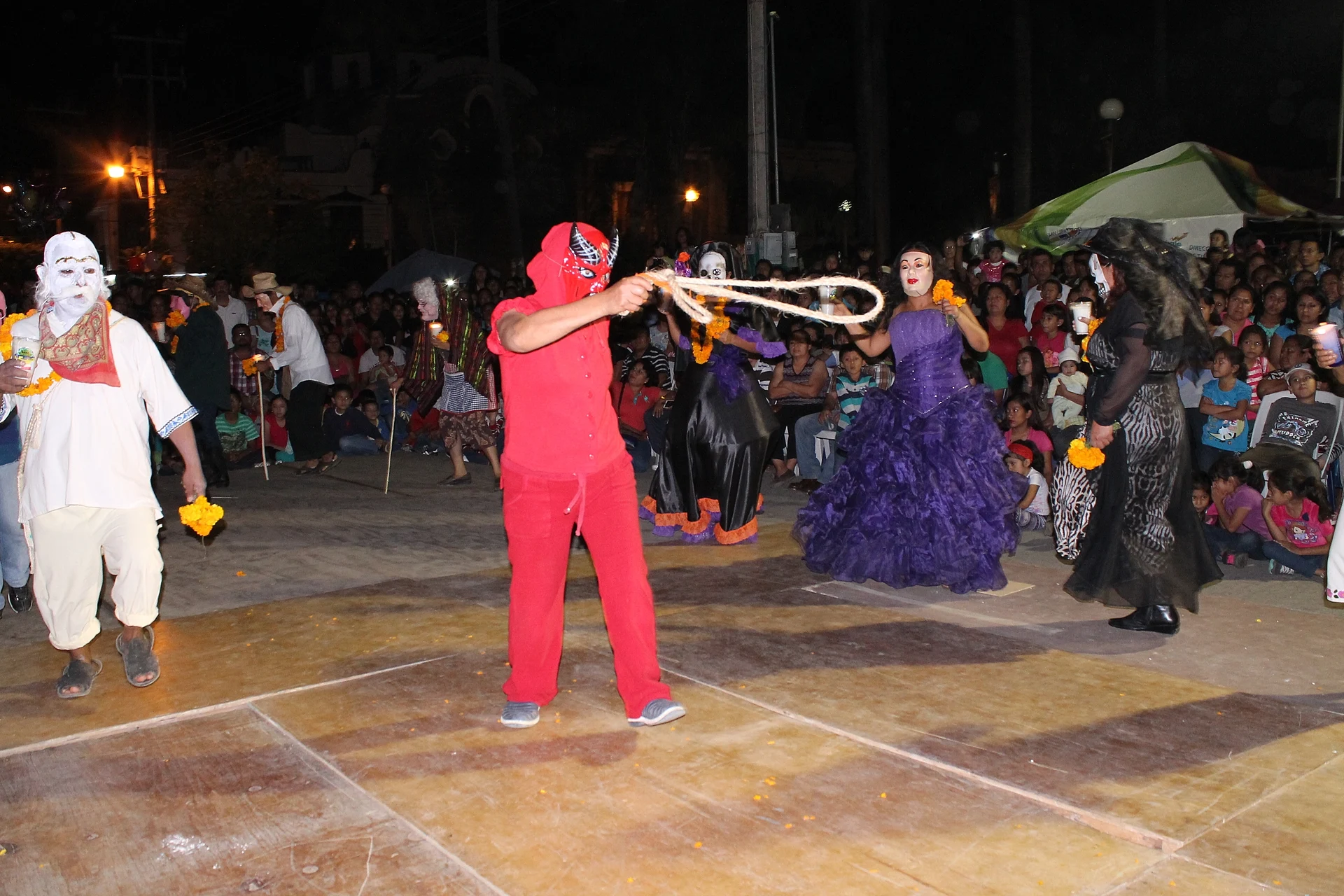
The image of Xantolo is the comparsa: a troupe of men, women and children in masks and costumes who dance for the dead in the streets, at the altars and in the plazas. The cast varies from town to town, but the recurring characters are the vaquero or caporal who leads the group, Death, the devil with his whip, the old man and the old woman, and in some places the pregnant woman. The dances are called vinuetes, and the music is son huasteco played by a trío of violin, huapanguera and jarana. The disguise is believed to protect the dancers from wandering spirits, and the huehues in turn keep evil spirits away from the houses they visit.
Each region has its own style. In San Martín Chalchicuautla the Coles lead the parade with the Mamanina, the community's mother, and Comanches in feather headdresses; in Chapulhuacanito, a Nahua community of Tamazunchale, devils in suits and black leather masks lead coles and viejas in painted wooden masks. Joining a comparsa is not a one-off: dancers commit to it for years, and in some Nahua communities they may not take off their costume until November 4, after a cleansing with lemongrass and copal smoke.
Xantolo begins on September 29, the feast of San Miguel Arcángel, when families set out the first small offering and the comparsas hold the bajada de máscaras: the masks, kept all year in sacks up in the rafters, are brought down, checked, repaired and repainted, then purified with copal smoke and prayers and offered aguardiente before anyone may dance in them. Masks are carved in cedar or pemoche wood, or made of papier-mâché, and are blessed before use. In Aquismón, whose patron is San Miguel, the date doubles as the town's own feast.
Two more offerings follow in many communities. On October 18, San Lucas, the second offering is for those who died tragically: in the Nahua villages of the Veracruz and Hidalgo Huasteca it is dedicated to people killed in accidents or by violence, with a cross decorated with white flowers set outside the house. On October 28, San Judas Tadeo, a third offering is laid in places such as Huejutla, and around that date families begin building the flower arch.
The arch, the altar and the food
The Huasteca altar is framed by an arco: four posts at the corners and crossbars bent into two arches, covered in cempasúchil and palm, from which hang oranges, bread, sweets and fruit. The arch marks the entrance to the world of the dead, and a path of marigold petals runs from it to the door so the souls can find their way in. October 30 is the day of the flower market and of building the altar. In Nahua homes the offering stands on a table with an embroidered cloth; Tének families often lay it on the ground, touching the earth.
The children's offering on October 31 is sweet and mild, with no chile; the adults' on November 1 brings tamales, mole, coffee, chocolate, beer and aguardiente. The dish of the season is zacahuil, the giant Huastec tamal, with bocoles and bolim. If you are invited into a house to eat from the offering, accept: the dead have already taken the essence of the food, and turning it down is considered disrespectful.
Tamazunchale, Tancanhuitz, Huehuetlán and Coxcatlán
Tamazunchale, on Highway 85 south of Xilitla, holds one of the biggest municipal Xantolo festivals in the state. In 2025 the town hall ran it from October 27 to November 2, with altars and a Concurso Regional de Comparsas on the big Xantolo stage in front of the municipal palace: sixteen comparsas competed, and Huehue Iwintinin took first place ahead of Yolopakilistli, the troupe that usually represents the town at the state festival. Out in the Nahua communities of the municipality, such as Chapulhuacanito and Atlajque, the old rituals of the huehues are kept.
Tancanhuitz, close to Aquismón, ties Xantolo to the voladores of the Tamaletom ceremonial center. Huehuetlán holds cemetery ceremonies with cempasúchil and copal, a huehue parade and a bajada de máscaras in its plaza, and serves zacahuil. Coxcatlán, a small municipality bordering Huehuetlán and Axtla de Terrazas, has no Xantolo program we could find published; go with a local guide or ask at the town hall what is planned.
Beyond San Luis Potosí: Huejutla and the Veracruz Huasteca
Xantolo does not stop at the state line. Huejutla de Reyes, in the Hidalgo Huasteca, stages one of the biggest municipal celebrations in the region; its 14th edition runs from October 30 to November 2, 2026, with a monumental altar of more than 1,100 square meters in the center (this year recreating the old stone bridge of the Tecoluco neighborhood, swept away by a flood in 1990), cuadrillas (as comparsas are called there) in Plaza 21 de Mayo, and a closing in which 2,026 candles are lit for the ánima sola. The town expects about 80,000 visitors. In Huejutla the Xantolo is officially closed only on November 30, when people believe the souls finally leave. In the Veracruz Huasteca, Ixhuatlán de Madero keeps the full cycle of offerings, from San Miguel to a meal in the cemetery on November 3, and in Tantoyuca the offering stays up for eight days, until the ochavario.
Day by day, 2026
San Miguel: first offering and bajada de máscaras
Xantolo opens. Families set out the first small offering, and the comparsas take down, repair and purify their masks with copal. Aquismón also celebrates its patron saint.
San Lucas: offering for those who died tragically
The second offering of the cycle, kept especially in the Nahua communities of the Hidalgo and Veracruz Huasteca, is for the dead of accidents and violence.
Xantolo comes to the state capital
The sixth Xantolo se Vive en tu Ciudad festival brings music, dance, altars, masks and food to San Luis Potosí city, Soledad de Graciano Sánchez and Villa de Pozos from October 23 to 25 (it opened in Matehuala on October 16 and 17).
San Judas: third offering, arches begin
A third offering in places such as Huejutla, and families begin building the flower arch. In 2024 Aquismón held a comparsa contest this afternoon.
Día de las flores: altars go up
Flower markets in the morning, arches and altars finished by night. The Huasteca stage of the state's Xantolo program runs from today to November 2, and Huejutla (Hidalgo) opens its 14th Xantolo with a school parade and the inauguration of its monumental altar.
The angelitos arrive
The children's souls are received with a sweet offering and clay toys; children go door to door asking for treats. Comparsas dance in the plazas in the evening; in 2024 Aquismón held its parade and comparsa contest at 5 pm at the DIF esplanade.
The adults' souls: the big night
The most intense day. The adults' offering goes on the altar at midday, neighbors exchange offerings, huehues dance through the streets and the plazas, and families keep vigil through the night with a trío huapanguero.
Cemeteries and xantolo chiquito
Graves are cleaned and decorated, with Mass and meals in the cemeteries. At night a last offering, the xantolo chiquito, and in some communities the comparsas begin their unmasking, the destape.
The huehues take off their masks
In some Nahua communities dancers keep their costume on until today, and remove masks only after a cleansing with lemongrass and copal.
San Andrés: farewell to the souls
In many communities the souls are believed to stay all November. On the last day the offering is renewed one last time, and the dried cempasúchil is gathered as seed for next year. Huejutla officially closes its Xantolo today.
Getting there
From Ciudad Valles
Valles is the hub. Aquismón is about 50 km away, roughly an hour; Tancanhuitz about 65 km. Xilitla is about 100 km south on Highway 85, and Tamazunchale a little farther down the same road. Second-class buses run hourly to Xilitla and Tamazunchale, and colectivos serve the smaller towns, but after dark on the big nights a car or a hired driver is far easier.
From San Luis Potosí
Take Highway 70 east through Rioverde to Ciudad Valles; allow four to five hours with the mountain stretch. Buses from the capital's terminal run to Valles through the day, and Xilitla has its own direct buses to San Luis Potosí.
From Querétaro
Highway 120 crosses the Sierra Gorda through Jalpan de Serra and meets Highway 85 at Xilitla. It is a beautiful but slow mountain road with tight curves: drive it in daylight and count on four to five hours. Querétaro airport (QRO) is the closest big one on this side.
From Mexico City
By bus, overnight services from Terminal Norte reach Ciudad Valles in about ten hours, and there are buses to Xilitla too. Driving to Xilitla is about 340 km, five and a half hours or more, either via Querétaro and the Sierra Gorda or via Pachuca and Highway 85 through Tamazunchale.
From Tampico
Tampico airport (TAM) is the nearest with regular flights. Highway 70 runs west to Ciudad Valles, and from there Aquismón is another hour; plan on about three hours to Aquismón. Xilitla also has direct buses to Tampico.
From Monterrey
Direct buses run from Monterrey to Ciudad Valles, and some continue to Xilitla; it is a long overnight trip. By car, head south through Ciudad Victoria and Ciudad Mante on Highway 85.
Where to stay
Ciudad Valles has the most hotels, the bus connections and the restaurants, and sits within an hour or two of everything on this page, so it is the usual base. Xilitla is the more beautiful place to sleep, with small hotels and posadas, among them El Castillo, Edward James's former house in the center; it is the better base for Tamazunchale and the southern towns, and for Las Pozas. Aquismón has a handful of modest hotels and cabins that also serve visitors to the Sótano de las Golondrinas and Tamul; staying there puts you in the middle of the Tének celebration.
In 2026 October 31 and November 1 fall on a Saturday and Sunday, and according to press reports the state government has also suspended classes and government work on October 29, 30 and November 2, so many potosinos will have five days off and head to the Huasteca: book now. The governor recommended visiting cemeteries on the Thursday or Friday, October 29 or 30, to avoid the crowds.
The Tének heart of the Huasteca and the closest Pueblo Mágico to Tancanhuitz, Huehuetlán and Coxcatlán. Xantolo here starts with San Miguel, the town's patron, on September 29. In recent years the municipality has scheduled comparsa contests, a parade and a crafts market in the last days of October (in 2024: October 28 and 31), and families lay many of their offerings on the floor in the Tének way. A good base if you want to be in the middle of it rather than drive in from Valles.
When
Offerings from September 29; comparsas in the plaza at the end of October; family altars October 31 and November 1; cemeteries November 2. Ask the town hall for the 2026 program.
Getting there
About 50 km (an hour) from Ciudad Valles; Tampico airport (TAM) is about three hours away.
The prettiest place to sleep in the southern Huasteca, and the gateway to Tamazunchale, 50 km down Highway 85. Xilitla's own Xantolo has mixed local and visiting comparsas, an altar contest, a catrina parade and an altar for Edward James and Leonora Carrington. By day, Las Pozas, James's surrealist garden, makes the trip worth it even outside the festival.
When
Comparsas and altars in the center from October 30 or 31 to November 2; check the town hall for the 2026 program.
Getting there
About 100 km south of Ciudad Valles on Highway 85, with hourly buses; direct buses to San Luis Potosí, Mexico City, Tampico and Monterrey. From Querétaro, Highway 120 through the Sierra Gorda.
Tamazunchale· near Xilitla
A Nahua river town where the Moctezuma and Amajac meet, with a riverside market and one of the Huasteca's big Xantolo celebrations.
Tancanhuitz· near Aquismón
A hillside Tének town founded in 1522, once one of the state's four departmental capitals.
Huehuetlán· near Aquismón
A small Huasteca town with a 17th-century parish, an ancient tree in its plaza and a cave of offerings nearby.
Coxcatlán· near Aquismón
A Huasteca town with a 17th-century church and annexed convent, and the popular Pozas de Rosendo swimming holes nearby.
Etiquette
Xantolo is a family and community ritual first and a spectacle second. Ask before photographing an altar inside a house, a family at a grave or a dancer up close, and never touch a comparsa's masks: they have been blessed and are treated as sacred objects. If a family invites you to eat from the offering or to drink a little aguardiente, accept at least a taste; refusing is rude. Bring cash, since small communities rarely take cards, and plan your trip back without counting on phone signal in the sierra. In the cemeteries keep to the paths, keep your voice down and leave the candles and flowers where they are.
Questions
When is Xantolo 2026?
The main days are Saturday October 31 (children's souls), Sunday November 1 (adults) and Monday November 2 (cemeteries). The state's Xantolo program reaches the Huasteca from October 30 to November 2, 2026. The season itself began on September 29 and in many communities ends with the farewell to the souls on November 30.
What does Xantolo mean?
It is the Nahuatl form of the Latin sanctorum, "of the saints", from the Catholic feast of All Saints.
Is there a Xantolo program for the whole Huasteca?
No. The state Secretaría de Cultura runs a touring festival, and each municipality (Tamazunchale, Aquismón, Xilitla, Huejutla in Hidalgo) publishes its own program on its social media a few weeks before. The most traditional rituals happen in homes and small communities and are never on a program.
Who are the huehues?
Huehue means "old one" in Nahuatl. They are the masked dancers of the comparsas, who represent the ancestors and dance for the souls during Xantolo. Joining usually means a commitment of several years.
What should I eat during Xantolo?
Zacahuil, the giant Huastec tamal, plus tamales, bocoles, bolim, pan de muerto from wood-fired ovens, chocolate and fruit atole.
Is it free to see the comparsas?
Yes, the comparsas, parades and plaza events of the municipal and state programs are free. Las Pozas in Xilitla charges admission as usual.
Sources
Facts checked against these pages in October 2026. Programs change each year, so confirm dates with the town before you travel.