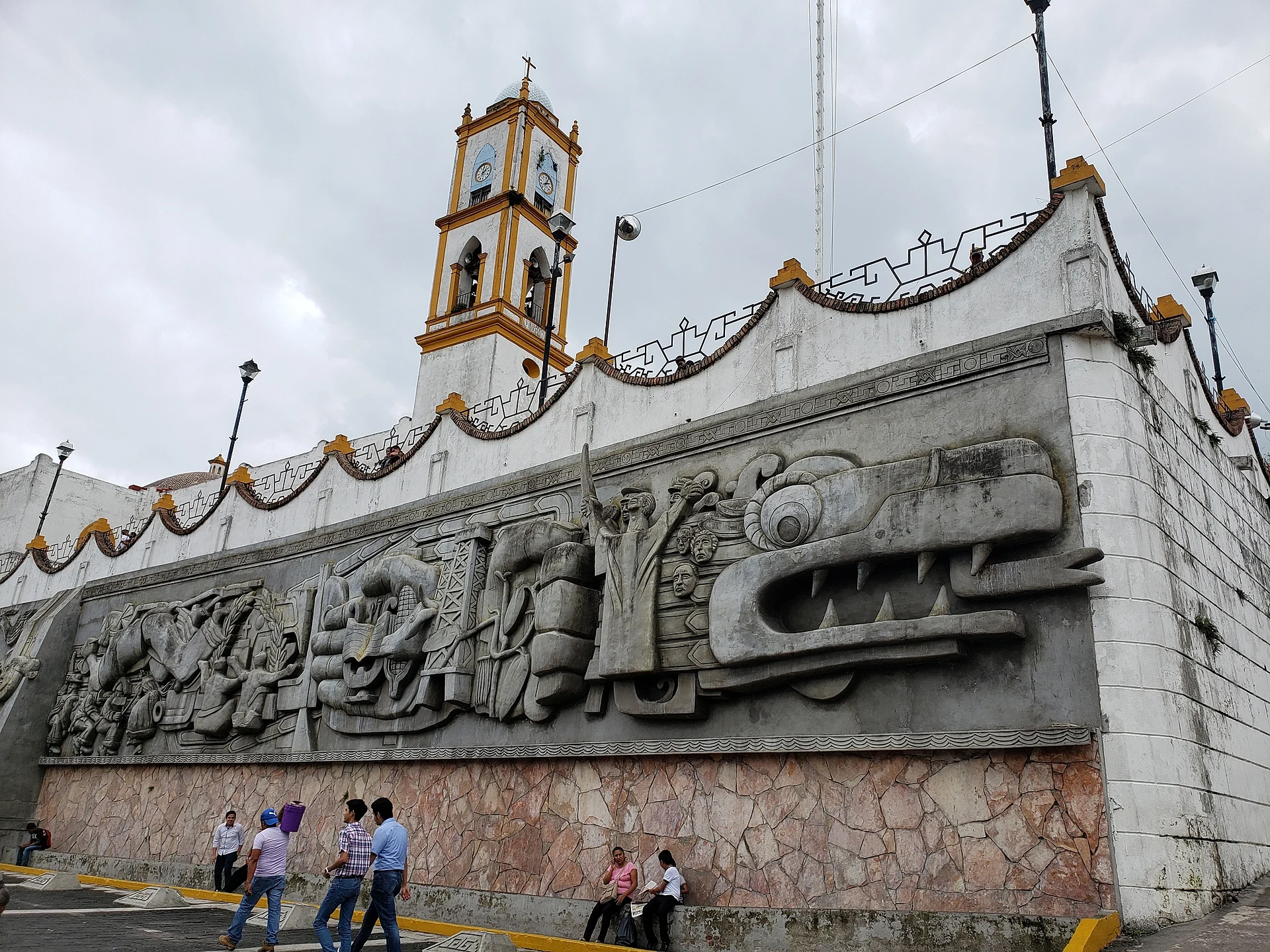
The bell tower of Papantla's church of Nuestra Señora de la Asunción above the carved relief of Totonac history on its atrium wall, Veracruz

Photo by Minerva Castro, CC BY-SA 4.0, via Wikimedia Commons

Oct 31 – Nov 2, 2026

Ninín 2026: the Totonac Día de Muertos in Papantla

In the Totonacapan the dead do not come for two days. They come for forty-two, from San Lucas to San Andrés, and they are fed from an altar that hangs in the air so they never touch the ground.

Remind me before Día de Muertos: Ninín in Papantla

Ninín is what the Totonac people of northern Veracruz call their festival of the dead, and the word itself is usually glossed as "the dead"; the INAH translates the festival as that of "those who have not died". It is the same season as Día de Muertos everywhere else, but in Papantla and the villages of the Totonacapan it is longer, older in its logic and tied to the land: the souls return with the cool north winds of autumn, at the time of the harvest of the sacred maize, and they are sent off at the end of November when the sowing starts again. Roads, cemeteries, houses and cornfields are swept clean before they arrive.

For a visitor that means two layers. One is private and lives in Totonac homes: the puchaw, the hanging altar, and the meals set out for the souls three times a day. The other is public: Papantla's town hall stages a Festival Ninín with processions from the cemetery, a monumental altar in front of the municipal palace, dances, masses in the panteones and food. The key days are the same as elsewhere, with the children's souls arriving at noon on October 31 and the adults at noon on November 1. The 2026 dates fall on a weekend: October 31 is a Saturday, November 1 a Sunday and November 2 a Monday, which means more visitors than usual. Add El Tajín, the great pre-Hispanic city fifteen minutes away, and the Voladores in front of the church, and Papantla is one of the most complete Day of the Dead trips in the country.

Forty-two days, from San Lucas to San Andrés

The Totonac calendar of the dead opens on October 18, the feast of San Lucas, the saint who in the Totonacapan took the place of the old Thunder deity. From that day families set off rockets or ring bells three times a day to guide the souls home. The first to arrive, according to the accounts gathered by Universidad Veracruzana anthropologist Crescencio García Ramos and others, are those who died by violence or by drowning. Between October 18 and 30 households prepare the altar and fire up the ovens; on October 30 and 31 the altars and flower arches go up.

The children's souls arrive at midday on October 31. At midday on November 1 they leave and the adults take their place, and on November 2 the adults go, accompanied to the cemetery, after which relatives, godparents and friends exchange offerings. A week later, on November 8 and 9, the aktumajat or octava says goodbye with a rosary to those who died a natural death. The souls of those who died violently stay longest: they are seen off on November 30, San Andrés, with offerings, rockets, music and dance, and then people go back to sowing the sacred maize. In Zozocolco de Hidalgo, in the Totonac sierra, paper lanterns are released that night to light their way.

The puchaw, an altar that hangs from the roof

The Totonac altar is called the puchaw, and the food set on it is the chaw. Unlike the stepped altars of central Mexico it hangs from the roof beams, because the dead must not touch the ground or they would be enchanted; they arrive floating on the air currents of the house. The puchaw is a square board that stands for the earth, covered with a white cloth sometimes embroidered with flowers and animals. Over it rises an arch braided from palm leaves, dressed with cempasúchil and terciopelo flowers and fruit, and hung with thirteen stars woven from coyol palm, the vault of the sky. Five candles burn on it, one at each corner and one in the middle, and thirteen yellow candles stand on the floor. Below go a washbasin, a towel, a chair and a petate, so the visitors can wash and rest.

The meals change three times a day, because the souls take the flavor from the steam: coffee and bread in the morning, tamales de cuchara filled with pork or picadillo at midday, chocolate and bread at night, soup for the children and tamales for the adults, with mole, rice, tortillas, cacao, chicharrones, totopos and fruit, cigarettes and aguardiente for the grown-ups and sweets or toys for the little ones. In the main house of the family, the k'antiyán, the children also dress a separate altar for the ánimas solas, the souls that no one remembers. Groups of alabanceros sing to open and close the portal through which the dead come.

The Festival Ninín in town

Papantla's town hall wraps the season in a Festival Ninín, and in 2026, under the motto "Donde la memoria florece" (where memory blooms), it started on the ritual date itself, Sunday, October 18. That afternoon there was a free workshop on crowns and papel picado at 4 pm in the small loop of the Parque Dr. Israel C. Téllez, a procession of the Huehues de Paso de Valencia from the municipal cemetery of the Santísima Trinidad to the central park, a San Lucas ceremony, the first of four "portales" in the program, the Ritual del Matarachín danced by the Huehues, and a videomapping projected on the mural of Totonac culture. The program for the main days had not been published when we checked on October 12.

Last year's gives the shape. In 2025 the festival ran from October 29 to November 2: on October 30 the Nitat Latamat walk left the Santísima Trinidad cemetery at 6 pm for the historic center, and at 7:30 pm the monumental altar was inaugurated on the esplanade of the municipal palace with the Danza de la Viejada; on November 1 there were prayers for the souls at 11 am in the Santísima Trinidad cemetery and alabanceros at night; on November 2 masses at 6 am in the Santísima Trinidad and 8 am in the Pujaxni cemetery; and on November 8 the walk went back from the center to the panteón. For flowers, candles and the rest of the altar, the streets along Paseo Reforma fill with cempasúchil and candle sellers in the days before the altars go up.

El Tajín and the Voladores

Voladores in red and white Totonac dress at the top of their pole in Papantla
Photo by Jesús Eduardo Arteaga Flores, CC BY-SA 4.0, via Wikimedia Commons

Fill the daytime with El Tajín, the city of the thunder, a UNESCO World Heritage Site since 1992 and one of the great cities of ancient Mesoamerica, fifteen minutes from the center of Papantla. The Pyramid of the Niches and the ball courts are best early, before the heat; the INAH lists the site as open every day from 9 am, with closing given as 5 pm or 6 pm depending on the source, and entry is free for children under 13, students and teachers with ID, and seniors. Papantla itself is the heart of Mexico's vanilla country, so buy the cured pods and vanilla figures in the market.

In town, the Danza de los Voladores, inscribed by UNESCO as intangible heritage in 2009, is performed in front of the church of Nuestra Señora de la Asunción, built by the Franciscans between 1570 and 1590: four flyers spin down on ropes from the top of a pole while a fifth plays flute and drum on the summit. The Monument to the Volador looks over the town from the hill above the center.

Day by day, 2026

  1. San Lucas: the first souls arrive

    The Ninín opens. Families set off rockets or ring bells three times a day to guide the souls home. The town's Ninín 2026 began today with a 4 pm papel picado workshop in the Parque Dr. Israel C. Téllez, the Huehues de Paso de Valencia procession from the Santísima Trinidad cemetery, the San Lucas ceremony and a videomapping on the Totonac mural.

  2. Altars and flower arches go up

    Families hang the puchaw and dress the arches. In 2025 the town's Nitat Latamat walk left the Santísima Trinidad cemetery at 6 pm, and the monumental altar opened at 7:30 pm in front of the municipal palace.

  3. Noon: the children's souls arrive

    The altar must be finished by midday, when the children's souls arrive. Soup, sweets and toys go on the puchaw. In town, the Friday danzón in the central park has been part of the festival.

  4. Noon: the adults take over

    At midday the children leave and the adults' souls arrive, received with tamales de cuchara, mole and aguardiente. In 2025 there were prayers for the souls at 11 am in the Santísima Trinidad cemetery and alabanceros at night.

  5. The adults leave, escorted to the cemetery

    Families walk the souls back to the cemetery and then exchange offerings with relatives, godparents and friends. In 2025 masses were said at 6 am in the Santísima Trinidad cemetery and 8 am in the Pujaxni cemetery.

  6. Aktumajat, the octava

    On November 8 and 9 a rosary sees off the souls of those who died a natural death. In 2025 the Nitat Latamat walk went from the center back to the panteón.

  7. San Andrés: the last farewell

    The souls of those who died violently are escorted to the cemetery with offerings, rockets, music and dance, and the sowing of the maize begins again. In Zozocolco paper lanterns are released to light their way.

Getting there

From Poza Rica
Papantla is about 23 km from Poza Rica, half an hour by car. ADO and Autobuses Eje del Golfo run roughly hourly from Poza Rica's bus station. El Tajín National Airport (PAZ), in Tihuatlán just outside Poza Rica, has had only intermittent service in recent years (the regional airline Aerus has flown to Reynosa, Tampico, Veracruz and Villahermosa), so check before counting on it.
From Veracruz (port and airport)
About 216 km up the coast, three hours or so by car. TRV runs direct buses roughly every two hours in a little over four hours. Veracruz airport (VER) has the most flights in the state.
From Mexico City
ADO buses leave the Terminal Norte (not TAPO) for Papantla about three times a day; the trip takes five to six hours. More departures go to Poza Rica, from where it is half an hour on. By car it is about 275 km, around four hours via Pachuca and the México–Tuxpan highway.
From Xalapa
ADO runs from Xalapa's CAXA to Papantla about hourly, in around four hours. Driving, the 195 km take about three hours. Combine it with La Cantada in Naolinco on the night of November 1 only if you have a car and a full day for the road.

Where to stay

Papantla has a modest choice of hotels around the center and the cathedral hill, enough for the Ninín, which draws far fewer outsiders than Cumbre Tajín in March. Book a few weeks ahead for October 30 to November 2 anyway. Poza Rica, half an hour away, is an oil city with many more hotels, including the business chains, and frequent buses into Papantla. If you want the sea, the beach town of Tecolutla is the other base in the Totonacapan; you would drive in for the evening events.

Photo by Alfonso Betancourt on Unsplash

Totonacapan, northern Veracruz

Papantla

The Totonac capital and the place to see the Ninín as both a family ritual and a town festival. A Pueblo Mágico since 2012, Papantla climbs a hillside around its 16th-century church of the Assumption, with the Monument to the Volador on top, murals of Totonac history, and a market that smells of vanilla. It works as a base for El Tajín, fifteen minutes away, and for the smaller Totonac towns of the sierra; the cemeteries of the Santísima Trinidad and Pujaxni are where the town's Ninín rituals happen.

When
Ritual calendar October 18 to November 30; children's souls arrive at noon on October 31, adults at noon on November 1, and leave on November 2. The town festival has run from about October 28 or 29 to November 2 in recent years.
Getting there
Half an hour from Poza Rica; ADO from Mexico City's Terminal Norte in five to six hours, from Xalapa in about four, from Veracruz in about four by TRV.
Where to stay
Tajín Hotel · ★★★ · 480 m from the center Find on Expedia Totonacapan Hotel · ★★ · 210 m from the center Find on Expedia Hotel La Quinta de los Leones Hotel · ★★ · 450 m from the center Find on Expedia
See them all on Expedia Booking.com
Vacation rentals on Vrbo Airbnb
Tours on Viator GetYourGuide

Full guide to Papantla → · Sources: El Ninín, festividad de los muertos entre los totonacas (UniVerso, Universidad Veracruzana, 2005) , Celebración totonaca de Día de Muertos se vincula con la cosecha del maíz (Universidad Veracruzana, 2021) , Papantla (Wikipedia)

Places to see nearby

  • El Tajín · near Papantla The great ancient city of the Gulf coast, with the Pyramid of the Niches, many ball courts and voladores at the gate.
  • Cuyuxquihui · near Papantla A small Totonac city founded as El Tajín declined, with a pyramid at the edge of a cliff and a large ball court.
  • Tecolutla · near Papantla Papantla's nearest beach town, at a river mouth on the Gulf, with a sea turtle camp and boat trips into the mangroves.

Etiquette

The puchaw lives inside the house and is a family's business; look at the altars the town sets out in public, and enter a home only if you are invited. If you are, do not touch the hanging altar or the food, which is for the souls, and accept whatever you are offered afterwards, because sharing the offering is part of the ritual. At the cemetery masses and the Nitat Latamat walk, keep a respectful distance, ask before photographing people and never use flash during prayers. Totonac custom holds that breaking the rules of the season brings misfortune, so follow the lead of the people around you. Late October in the Totonacapan is warm and humid with a chance of rain and of the first cool northers: bring light clothes, a rain shell and mosquito repellent. When the Voladores finish, they pass a hat; tip them.

Questions

What is Ninín?

It is the Totonac name for the festival of the dead in northern Veracruz and the neighboring part of Puebla. The word is usually translated as "the dead". It mixes pre-Hispanic beliefs tied to the maize harvest with the Catholic All Saints and All Souls, and lasts 42 days, from October 18 to November 30.

When do the souls arrive in 2026?

The first come on October 18, San Lucas (a Sunday in 2026). The children's souls arrive at noon on October 31 (Saturday) and the adults at noon on November 1 (Sunday); the adults leave on November 2. The octava is November 8 and 9, and the last farewell is November 30, San Andrés (Monday).

Why does the Totonac altar hang from the ceiling?

Because the dead must not touch the ground or they would be enchanted. They arrive floating on the air currents of the house, so the puchaw, the altar, is hung from the roof beams. Its square board stands for the earth and its arch of palm with thirteen stars for the sky.

Is there a Festival Ninín in 2026?

Yes. Ninín 2026, "Donde la memoria florece", opened on Sunday, October 18 with a papel picado workshop, a Huehues procession from the Santísima Trinidad cemetery and the San Lucas ceremony. The program for October 30 to November 2 had not been published as of October 12; in 2025 those days brought the Nitat Latamat walk, the monumental altar, prayers and masses in the cemeteries.

Can I visit El Tajín during Día de Muertos?

Yes. The archaeological zone opens every day from 9 am; go early, before the heat and the crowds. It is about fifteen minutes from Papantla, and entry is free for children under 13, students and teachers with ID, and seniors.

How do I get to Papantla?

Most people take a bus: ADO from Mexico City's Terminal Norte in five to six hours, from Xalapa in about four, or TRV from Veracruz in about four. From Poza Rica it is a half-hour hop. Flights into Poza Rica's El Tajín airport have been intermittent.

Sources

More Day of the Dead guides

Día de Muertos 2026 in Mexico's Pueblos Mágicos Pátzcuaro & Janitzio Huaquechula & Atlixco Oaxaca & Mitla Mixquic (Mexico City) Chignahuapan Xantolo, Huasteca Potosina Hanal Pixán, Yucatán Naolinco & La Cantada Tacámbaro Day of the Dead dates Near Mexico City Near Guadalajara Near Monterrey

Links open a partner site. We may earn a commission if you book, at no cost to you. See festivals in every Pueblo Mágico, month by month →